Content Strategy: How to Build One Step by Step in 2026
supawriter

A content strategy turns “we should post more” into a system that attracts the right audience, supports your marketing goals, and gets better results over time. If you’ve been publishing content but can’t explain what’s working, what to write next, or how to scale, you don’t need more ideas. You need a strategy.
You can build that strategy in a weekend and start executing the same week, especially if you centralize research, planning, SEO, and publishing in a single workflow. When it comes to turning strategy into consistent output, Supawriter gives you a planning and production workflow that helps your team move faster without lowering quality.
What a content strategy is (and what it is not)
A content strategy is a documented plan for creating, releasing, managing, and improving content so it drives specific business outcomes. It covers what you’ll publish, who it’s for, why it matters, where it will live, how you’ll produce it, and how you’ll measure success.
Mailchimp describes content strategy as a comprehensive plan for creating, releasing, and managing your content, including maintaining and engaging with your audience over time. Mailchimp’s content strategy guide is a solid baseline if you want a simple, non-technical definition.
Content strategy vs. content marketing vs. content plan
These terms get mixed up. Here’s the practical difference:
| Term | What it is | What it answers |
|---|---|---|
| Content strategy | The system and decisions behind your content | Who are we for, what do we stand for, what will we publish, and how will we win? |
| Content marketing | Using content to drive demand (leads, pipeline, revenue, retention) | How will content support acquisition and growth? |
| Content plan | The schedule and execution details | What are we publishing this week/month, in what format, on which channel? |
A content plan (calendar) without a content strategy usually turns into random output.
What a good strategy includes
At minimum, your strategy should document:
- Goals and KPIs tied to the business
- Target audience and what they need at each stage
- Messaging, positioning, and voice so content sounds like one brand
- Content pillars (the themes you want to be known for)
- Formats and channels (blog, email, video, social, etc.)
- Workflow and resourcing (who does what, when)
Siteimprove highlights goals and KPIs, target audiences, messaging and voice, and content pillars/topics as key parts of a content strategy framework. Siteimprove’s content strategy framework overview can help align stakeholders on the essentials.
Common mistakes that make strategies fail
Most content strategies fail for predictable reasons:
- Too many goals at once (everything becomes “priority”)
- No clear audience insight (content is generic and doesn’t convert)
- No distribution plan (good posts that no one sees)
- No operating system (no calendar, no workflow, no ownership)
- No measurement loop (you keep publishing without learning)
Fix those five and you’re already ahead of most teams.
Set goals, KPIs, and guardrails before you create anything
Your content strategy should start with clarity, not keywords.
Choose one primary goal and two supporting goals
Pick one primary goal for the next 90 days. Examples:
- Increase qualified organic traffic to product pages
- Generate more sales-qualified demo requests
- Reduce churn by improving onboarding and product education
Then add two supporting goals that help the primary goal. For instance, if your primary goal is “more qualified demos,” supporting goals could be “grow email subscribers” and “increase comparison page traffic.”
Turn goals into measurable KPIs (SMART)
Siteimprove recommends mapping goals to measurable KPIs and using SMART goals so success is clear and time-bound. Siteimprove’s goal and KPI section includes an example like “increase organic traffic by X% in Y months,” which is the level of specificity you want.
Use this table to make your strategy measurable:
| Goal | KPI | Target | Measurement source | Review cadence |
|---|---|---|---|---|
| Grow qualified traffic | Non-branded organic sessions to core pages | +20% in 90 days | GA4, Search Console | Weekly |
| Improve lead quality | Demo-to-SQL rate from content | +10% in 90 days | CRM, attribution | Monthly |
| Build authority | Top-3 rankings for priority topics | 10 keywords | Search Console, rank tracker | Monthly |
Avoid vanity metrics as your “north star.” Pageviews are fine, but they rarely tell you whether your content is helping the business.
Define guardrails: scope, resources, approvals, compliance
Before you plan topics, define the constraints:
- Scope: Which product lines, markets, and personas are in scope?
- Resources: Who writes, edits, designs, and publishes?
- Approvals: Who can ship content, and what is the turnaround time?
- Compliance: Any legal, medical, financial, or brand requirements?
This prevents strategy drift and keeps your calendar realistic.
Know your audience and your message (so your content converts)
If your audience definition is “SMBs and enterprises,” your content will sound like it.
Build lightweight personas and jobs-to-be-done
You don’t need a 30-page persona deck. You need a usable one-page snapshot per key segment:
- Role and context (who they are)
- The job they’re trying to get done
- What success looks like
- Top objections and risks
- Where they look for answers
To get real inputs quickly, pull from:
- Sales call notes and objections
- Support tickets and recurring questions
- Onboarding calls and implementation friction
- Search queries in Search Console
Map questions to funnel stages
Your content should meet people where they are:
- Awareness: “What is…”, “how does…”, “examples of…”
- Consideration: “best…”, “alternatives…”, “template…”, “pricing…”
- Decision: “case study”, “implementation”, “migration”, “ROI”, “security”
A simple rule: if you only publish awareness content, you’ll grow traffic but struggle to convert. Balance the funnel.
Document messaging, voice, and differentiation
Siteimprove calls out messaging and voice as a core framework component because it keeps multi-author content consistent. Siteimprove’s messaging and voice section also recommends using examples so writers can follow it.
Write down:
- 3 messaging pillars (what you repeatedly stand for)
- Tone (professional, direct, friendly, etc.)
- Words you use and words you avoid
- Your unique POV (what you do differently than competitors)
This is what makes your content feel like a brand instead of a collection of posts.
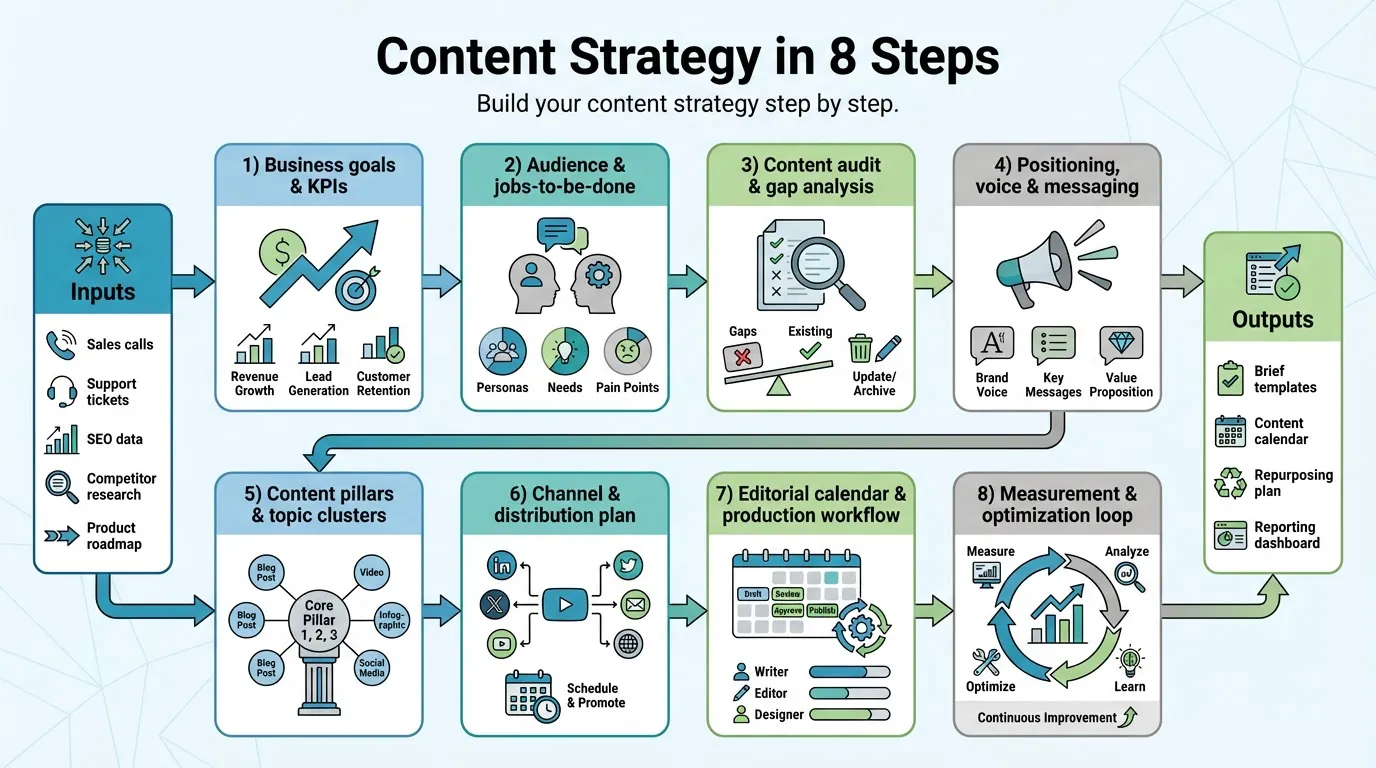
Build your content strategy step by step
Now you’re ready to plan the content itself.
Run a content audit and gap analysis
Start by inventorying what you already have:
- Top pages by organic traffic
- Pages that convert (assists and last-click)
- Content that ranks on page 2 (quick win updates)
- Outdated posts that should be refreshed or consolidated
Then run a gap analysis:
- What topics do competitors cover that you don’t?
- What questions does your audience ask that you haven’t answered?
- Which high-intent keywords are missing a dedicated page?
This is where you decide what to keep, update, merge, redirect, or delete.
Create content pillars and topic clusters
Pick 3 to 5 content pillars aligned to your product and audience needs.
Example for a B2B SaaS company:
- Getting started (implementation, onboarding, adoption)
- Use cases (by role or department)
- Best practices (how to do the job better)
- Comparisons (alternatives, “X vs Y”)
- Proof (case studies, benchmarks)
Under each pillar, build topic clusters:
- Pillar: “Content strategy”
- Cluster topics: content audit, content calendar, content pillars, measurement, workflow
Clusters help you build topical authority and a cleaner internal linking structure.
Plan channels, distribution, and repurposing
A strategy that ends at “publish” stops too early.
Decide:
- Primary channel: Usually your blog or resource center
- Support channels: Email, LinkedIn, YouTube, webinars, community
- Distribution motion: SEO, newsletter, social, partnerships, creators
Then set simple repurposing rules. For example:
| Source content | Repurpose into | When |
|---|---|---|
| 2,500-word blog post | 5 LinkedIn posts + 1 email | Week of publish |
| Webinar | Blog recap + short clips | 1 to 2 weeks after |
| Case study | Sales enablement deck + landing page | As soon as approved |
In 2025, IAB reported U.S. creator economy ad spend growing from $13.9B (2021) to $29.5B (2024), with a projection of $37B in 2025. That’s one reason distribution and creator-led channels get more attention now. TV Tech’s coverage of the IAB report summarizes the figures.
Create a content calendar and production workflow
Your calendar is where strategy becomes execution.
A simple weekly cadence that works for many teams:
- 1 SEO-driven blog post
- 1 distribution email
- 3 to 5 social posts (repurposed)
- 1 content refresh/update (older post)
Define workflow stages:
- Brief → Draft → Edit → SEO checks → Design/visuals → Approval → Publish → Distribute → Update
A consistent publishing rhythm is easier to maintain with Supawriter because it brings SERP research, long-form drafting, SEO optimization, scheduling, and publishing workflows into one place.
Templates, examples, and measurement that keep your strategy working
This is the part a lot of “ultimate guides” skip: the fill-in documents and the operating rhythm.
A fill-in content strategy template (one page)
Copy this into your doc and fill it in:
| Section | Your answers |
|---|---|
| Primary goal (90 days) | |
| Supporting goals | 1) 2) |
| KPIs and targets | |
| Primary audience segment | |
| Top 5 audience questions | 1) 2) 3) 4) 5) |
| Messaging pillars | 1) 2) 3) |
| Voice notes | |
| Content pillars (3 to 5) | |
| Channels | Primary: Support: |
| Publishing cadence | |
| Workflow + owners | |
| Distribution checklist | |
| Measurement cadence | Weekly: Monthly: Quarterly: |
If you keep this current, you have a strategy. Everything else is details.
Mini examples: SaaS blog and social media content strategy
Two quick examples to model.
Example 1: SaaS blog content strategy
- Goal: Increase non-branded organic demos
- KPIs: Top-3 rankings for 10 commercial keywords, demo assists from organic
- Pillars: Comparisons, implementation, best practices, case studies
- Cadence: 1 new post/week + 1 refresh/week
- Distribution: Email weekly + LinkedIn repurposing + internal linking updates
Example 2: social media content strategy (LinkedIn-first)
- Goal: Build brand demand and sales conversations
- KPIs: Profile views, website clicks, inbound DMs, assisted conversions
- Pillars: POV, practical how-tos, customer proof, behind-the-scenes
- Cadence: 4 posts/week, 1 carousel every two weeks
- Repurpose: Every blog becomes 3 to 5 posts + 1 short narrative story
Both examples have a clear goal, a limited set of pillars, and a publishing cadence that matches team capacity.
Measurement rhythm: weekly, monthly, quarterly optimization
Measurement is where you protect ROI.
- Weekly (30 minutes): traffic trends, pages slipping, new rankings, distribution performance
- Monthly (60 to 90 minutes): which topics converted, which formats worked, what to refresh next
- Quarterly (half-day): revisit pillars, update KPIs, prune content, plan next quarter’s themes
If you’re using AI in your workflow, tie it to outcomes. A SAS and Coleman Parkes study (reported by TechRadar) found high GenAI adoption in marketing and that many CMOs and marketing teams report ROI from GenAI initiatives. TechRadar’s coverage is the reference used here.
The practical takeaway: don’t use AI to publish more random content. Use it to publish more of the content that supports your goals.
A content strategy is only as good as your ability to execute it consistently, measure it honestly, and refine it without starting over every month. If you want a system that helps you research SERPs, generate long-form drafts in your brand voice, schedule content, and publish to any website from one place, explore Supawriter and turn your strategy into a repeatable engine.
Grow your traffic on autopilot now
Join thousands of users already using our platform.