Automate SEO in 2026: Tools and Workflows to Scale Rankings
supawriter
If you're trying to automate SEO, you're probably feeling the same pressure every growth team feels in 2026: more pages, more keywords, more competitors, and not enough hours in the week.
A lot of SEO work is repeatable. When you systematize it, you ship faster, make fewer mistakes, and keep output consistent. You also don't need to duct-tape 12 tools together to do it. A publish-ready workflow can be simple with Supawriter, especially if your goal is to scale content without losing your brand voice.
what SEO automation is (and why teams use it in 2026)
SEO automation means using software, and often AI, to handle recurring SEO tasks with minimal manual work, like monitoring rankings, running technical audits, generating briefs, and producing reports.
SEO automation vs AI SEO
Automation is about repeatable processes: collect data, check rules, trigger alerts, create tickets, publish updates.
AI SEO is where models help with pattern recognition and generation, like summarizing SERP themes, drafting content, suggesting internal links, or proposing meta titles.
They overlap, but they're not the same. A strong setup uses both: automation to keep work moving reliably, and AI to speed up the parts that normally take real thinking time.
where automation saves the most time
The biggest wins tend to come from tasks that are:
- frequent (weekly or daily)
- structured (the same inputs each time)
- easy to validate with checks
For example, LearningSEO lists high-leverage automated tasks like keyword research, rank tracking, technical audits, XML sitemap generation, meta tag analysis, and SEO reporting. That's a solid starting point. (LearningSEO)
the tradeoffs: quality gates and governance
Automation can scale mistakes.
Enterprise SEO teams use automation to enforce quality gates, reduce handoffs, and create audit trails. That's the difference between a few AI-written posts and a process you can trust. (Siteimprove)
what to automate in SEO (and what not to)
A practical rule: automate collection, checking, and coordination. Keep humans on strategy and final decisions.
automate: research, monitoring, and reporting
These are low-risk and immediately useful:
- rank tracking and alerts for priority keywords
- Search Console anomaly detection (click drops, indexing issues)
- weekly SEO reporting to Slack/email
- competitor change monitoring for key pages
If you're building your SEO foundation, pair automation with a clear plan. This guide on how to grow organic traffic in 2026 helps you choose what to track so your dashboards don't become noise.
automate: on-page checks and internal linking suggestions
On-page SEO is well-suited to automation because it's checklist-driven.
What you can automate safely:
- missing titles, meta descriptions, H1 issues
- thin content flags
- image alt text gaps
- broken links and redirect chains
- internal linking opportunities (based on topic clusters)
If you want the checklist version your team can operationalize, keep this on-page SEO checklist for 2026 handy and turn it into rules inside your workflow.
do not automate: strategy, positioning, and final editorial judgment
Don't fully automate:
- ICP positioning and product messaging
- topic prioritization tied to pipeline or retention
- claims that require primary-source verification
- compliance, legal review, brand risk
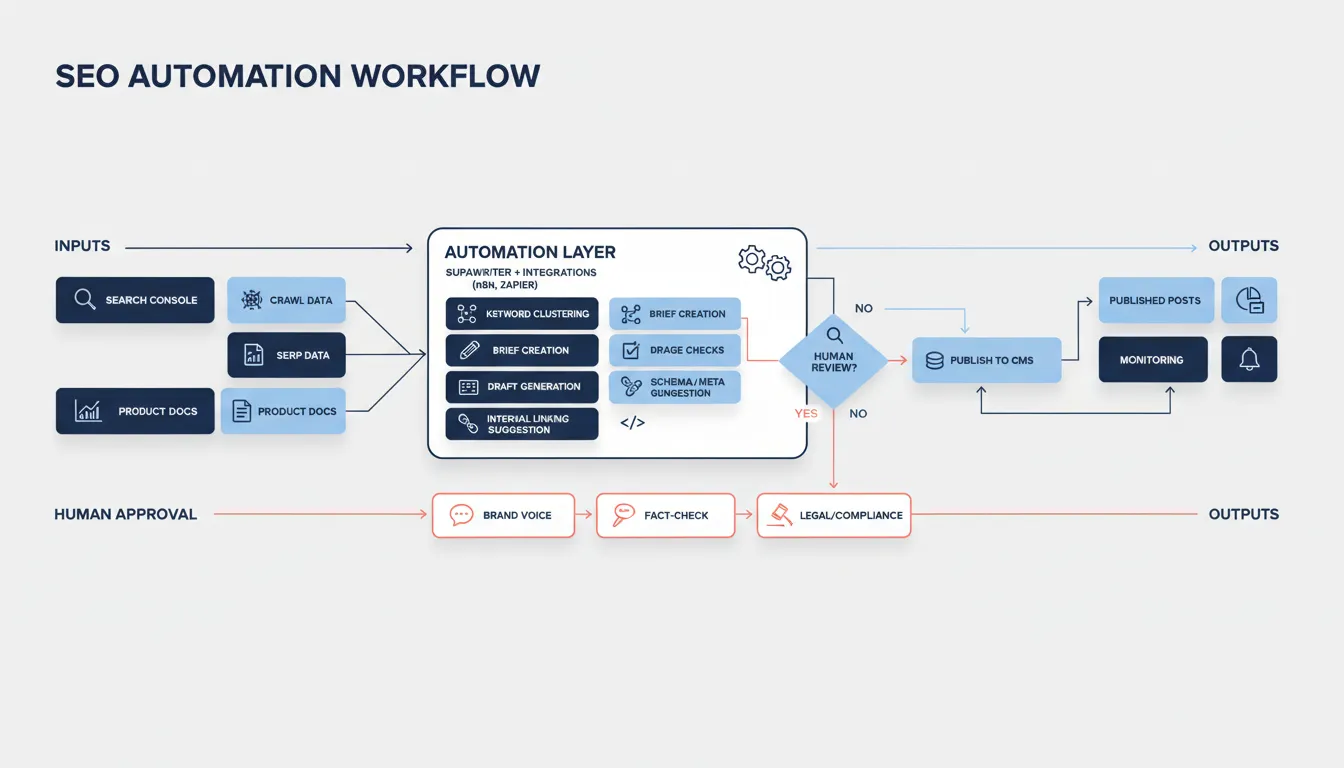
You can use AI to speed up drafts, but you still want a human approval step for:
- factual accuracy
- brand voice
- whether it actually helps the reader
When it comes to scaling quality without letting things drift, Supawriter is most useful when you treat it like a workflow layer: it can speed up planning, drafting, and scheduling, while your team owns the editorial bar.
best SEO automation tools for 2026 (10 options compared)
Below are 10 common tools and categories that show up across modern stacks. The best tool is the one that fits your workflow and reduces overlap.
Supawriter
Supawriter is an AI content engine aimed at automating parts of the SEO content pipeline, like planning, drafting, and getting content ready to publish.
What matters in 2026 is that Supawriter doesn't show up in several roundups of widely reviewed, top SEO tools. According to Darkroom Agency and TopicalMap.ai, the most commonly cited AI SEO tools for 2026 are other platforms, so specific claims about Supawriter's full feature set (for example, real-time SERP analysis or fact verification) are plausible but not independently confirmed in those sources.
Key features Supawriter is typically used for workflow-oriented content production, for example drafting long-form pages, keeping copy consistent with brand voice, and helping teams move from brief to draft to publish. Exact capabilities vary by plan and setup.
Pros
- a good fit if you want fewer handoffs between brief, draft, and publishing
- helpful when you're trying to keep output consistent across multiple writers
Cons
- if you need deep rank tracking or dedicated technical audits, you may still need specialized tools
Best for SaaS founders and growth teams who want content production to feel like a repeatable process, not a weekly scramble.
Pricing Varies by plan and usage. Evaluate it based on how much time it saves on briefing, drafting, and publishing.
Semrush
Semrush is an all-in-one SEO suite commonly used for keyword research, rank tracking, competitor analysis, and reporting.
Key features include keyword databases, position tracking, site audits, and competitor research.
Best for teams that need a single research and tracking hub.
Ahrefs
Ahrefs is widely used for backlink analysis, competitive research, and keyword discovery.
Key features include link analysis, content gap research, and rank tracking.
Best for teams doing serious competitive analysis and link-driven growth.
Screaming Frog SEO Spider
Screaming Frog is a desktop crawler that helps with technical checks across a site.
Key features include crawl diagnostics, redirects, canonical checks, and metadata extraction.
Best for technical SEO audits and recurring site health checks.
Siteimprove
Siteimprove focuses on SEO automation through governed workflows and quality gates, especially for larger organizations.
Key features include governance, monitoring, quality assurance, and enterprise workflows.
Best for enterprise or regulated environments.
n8n
n8n is a workflow automation platform used to connect SEO tasks across tools.
A relevant example is n8n's workflow template for automating SEO-optimized WordPress posts using Google Sheets and AI, including content, titles, images, meta tags, and publishing. (n8n template)
Zapier
Zapier is a no-code automation tool that can connect lightweight SEO workflows.
Best for simple alerts, handoffs, and reporting automations.
Google Search Console
Search Console is a key diagnostic tool for how Google sees your site.
Best for monitoring performance and feeding automation triggers.
Google Analytics
Analytics helps connect SEO work to on-site behavior and conversions.
Best for measuring SEO impact beyond rankings.
Schema/structured data helpers
Structured data tools help generate and validate schema without hand-writing JSON-LD every time.
Best for teams scaling templates and wanting consistent markup.
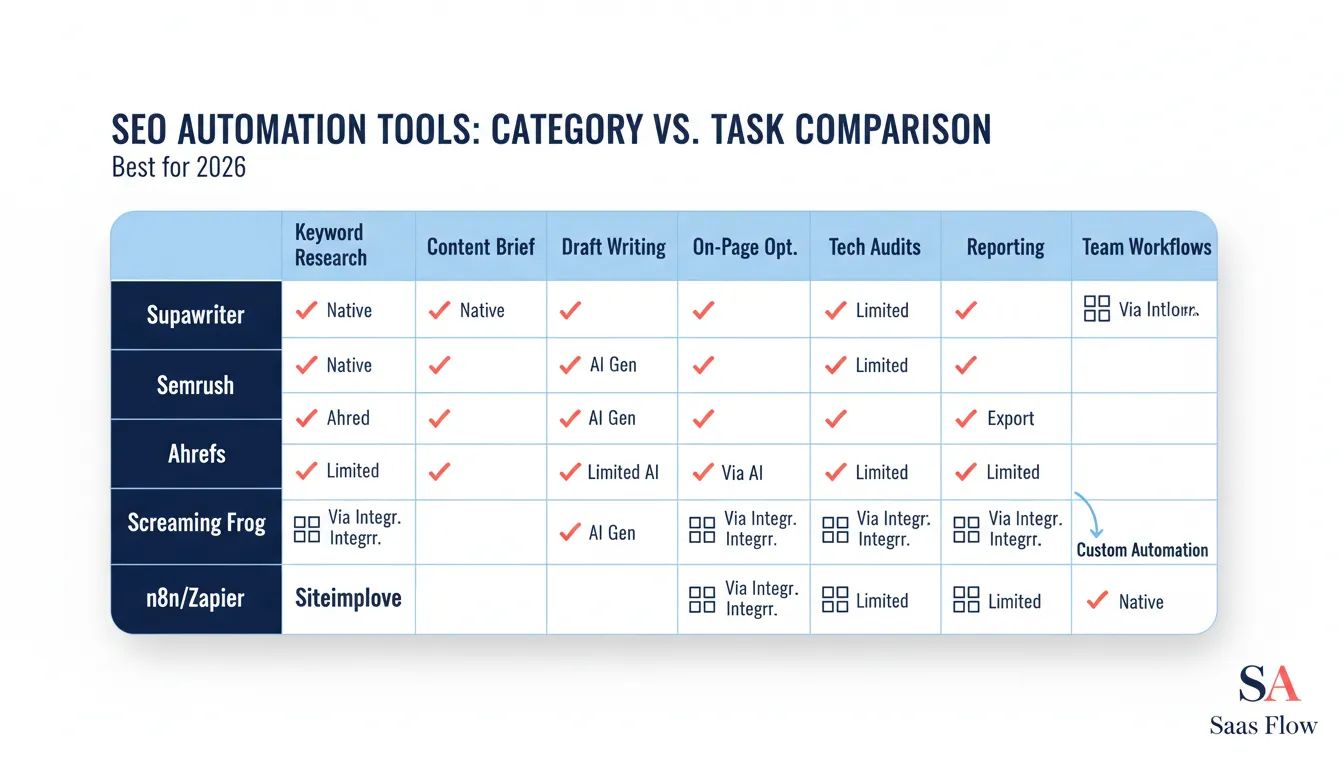
Here's a quick comparison so you can see overlap at a glance:
| Tool | Keyword research | Briefs | Draft writing | On-page optimization | Technical audits | Reporting | Publishing automation | Team workflows |
|---|---|---|---|---|---|---|---|---|
| Supawriter | Yes | Yes | Yes | Yes | Some | Yes | Yes | Yes |
| Semrush | Yes | Limited | No | Some | Yes | Yes | Limited | Some |
| Ahrefs | Yes | Limited | No | No | Limited | Some | No | Limited |
| Screaming Frog | No | No | No | No | Yes | Export-based | No | No |
| Siteimprove | Some | Limited | No | Some | Yes | Yes | CMS-dependent | Yes |
| n8n/Zapier | Via integrations | Via integrations | Via integrations | Via integrations | Via integrations | Via integrations | Yes | Some |
| Search Console | Query insights | No | No | No | Indexing-focused | Limited | No | No |
3 SEO automation workflows you can copy today
Tools don't automate SEO. Workflows do.
workflow 1: keyword to brief to draft to publish
Goal: ship SEO content consistently without redoing the same thinking every week.
- Pull keywords and questions from your research tool (or Search Console).
- Cluster into topics and map to intent.
- Generate a content brief (structure, angle, entities, internal links).
- Draft the article.
- Run on-page checks (titles, headings, internal links, images, schema).
- Publish and schedule updates.
If you're building the strategy layer first, use this step-by-step content strategy guide to define your clusters and targets before you scale.
Where Supawriter fits best: steps 3 through 6, especially when you want drafts that match your brand voice and come with basic on-page elements like titles and internal links.
workflow 2: technical SEO monitoring and alerting
Goal: find issues before they turn into traffic losses.
- Run scheduled crawls (weekly) to detect broken links, redirect chains, duplicate titles, and indexation signals.
- Pull Search Console coverage and performance signals.
- Trigger alerts when thresholds are crossed (errors spike, clicks drop, pages deindex).
- Auto-create tasks in your tracker (Jira/Linear) with page URLs and recommended fixes.
This is the side of automation that pays off quietly: fewer "why did traffic drop?" incidents.
workflow 3: refresh and republish existing content at scale
Goal: compound traffic by updating what already ranks.
- Identify decaying pages (clicks or position trending down).
- Re-check SERP intent and competitor structure.
- Update sections, add missing entities, and improve clarity.
- Add internal links to newer, relevant pages.
- Republish and annotate changes.
If your team struggles with internal linking discipline, you'll get extra mileage from building a repeatable process. You can also tighten your understanding of SEO content fundamentals with what SEO content is and how to create it in 2026.
how to choose an SEO automation stack (without creating chaos)
Your biggest risk isn't choosing the wrong tool. It's building a system no one trusts.
start with one source of truth and clean inputs
Decide what's authoritative for:
- keyword targets
- URL mapping
- internal linking rules
- publishing and approvals
A messy spreadsheet becomes a messy site.
measure the right outputs (not vanity metrics)
Rankings matter, but automation is also about throughput and quality.
Track:
- time from idea to publish
- pages shipped per month
- percent of pages passing on-page checks on first review
- refresh cadence for top URLs
- leads, signups, or qualified conversions from organic
set AI and automation guardrails
Before you scale:
- define what must be human-reviewed
- create brand voice and claim standards
- log what was changed and why
This is where Supawriter can help growing teams: it can take care of the repetitive parts of drafting and production, while you keep the review standards tight.
If your goal for 2026 is to automate SEO without turning your blog into an assembly line of generic posts, look at how Supawriter fits into your planning, writing, and publishing workflow.
Grow your traffic on autopilot now
Join thousands of users already using our platform.