Blog Examples: 12 of the Best Blogs and Post Formats for 2026
supawriter

If you searched for blog examples, you probably want two things: inspiration you can borrow and a clear blueprint you can publish today.
This guide gives you both. You’ll get (1) a quick checklist for what “good” looks like, (2) copy-ready blog format templates, (3) a set of blog and roundup examples, including several lists that are updated for 2026, and (4) short samples for students, beginners, and personal bloggers. For inspiration, creators like RyRob publish updated “blog examples” roundups for 2026, and similar lists are updated regularly by Hostinger and Site Builder Report, but not every example below is specifically a “modern 2026” blog. (See RyRob’s blog examples list, Hostinger’s blog examples, and Site Builder Report’s blog examples.) If you want to turn inspiration into a repeatable publishing engine, Supawriter helps you generate long-form posts, optimize for SEO, and keep a consistent schedule.
What makes a good blog example (a quick checklist)
Before you bookmark a blog and try to model it, scan for signals that it’s actually working.
| What to look for | What it means | Quick self-check you can copy |
|---|---|---|
| Strong visual identity | Readers recognize the brand instantly | Do your colors, fonts, and imagery feel consistent across posts? |
| Clear voice and purpose | The blog knows who it’s for | Can you describe the audience in one sentence? |
| Quality, regular content | The blog feels active and trustworthy | Do you have a realistic cadence (weekly, biweekly, monthly)? |
| Easy navigation | Readers can find more content fast | Can users filter by category, topic, or use search? |
| Strategic CTAs | Traffic turns into subscribers, leads, or sales | Does each post offer a logical next step? |
This lines up with what Wix highlights in its “what makes a great blog” criteria: visual identity, voice/purpose, quality cadence, navigation, and CTAs. Wix’s roundup of blog examples is a useful reference for how many top-ranking pages package these takeaways.
Now add a few SEO-specific checks:
- Internal links that form topic clusters (not random links). If you want a framework, use this SEO content guide.
- Updated posts (fresh dates, revised screenshots, new stats) instead of abandoned archives.
- Search intent match (the post answers what the query really wants).
- Readable layout (short paragraphs, headings, lists, and images that support scanning).
Blog format examples by goal (with mini templates)
Most “blog examples” pages show sites. But a lot of people also want blog format examples and post structures they can reuse.
Here are three proven formats, each with a mini template you can paste into your editor.
How-to post template
Best for SEO traffic and evergreen queries.
Template:
- Hook: 2–3 sentences stating the problem and the outcome
- Who this is for
- What you need (tools, prerequisites)
- Step-by-step process (5–9 steps)
- Common mistakes
- Quick checklist recap
- CTA: subscribe, demo, download, or related post
Tip: This format is easy to scale with Supawriter because you can keep your voice consistent while producing long-form, structured guides.
Listicle post template
Best for comparisons, inspiration, and fast skimmability.
Template:
- Hook + promise (what the reader will choose/learn)
- What you considered (your criteria)
- The list (each item follows the same sub-structure)
- How to choose (decision rules)
- CTA
Case study post template
Best for credibility, B2B lead gen, and product-led growth.
Template:
- Context: who/what this is about
- The goal and constraints
- The approach (what you actually did)
- Results (metrics + timeframe)
- What you’d do differently
- Reusable lessons
- CTA
EEAT visual: blog format comparison
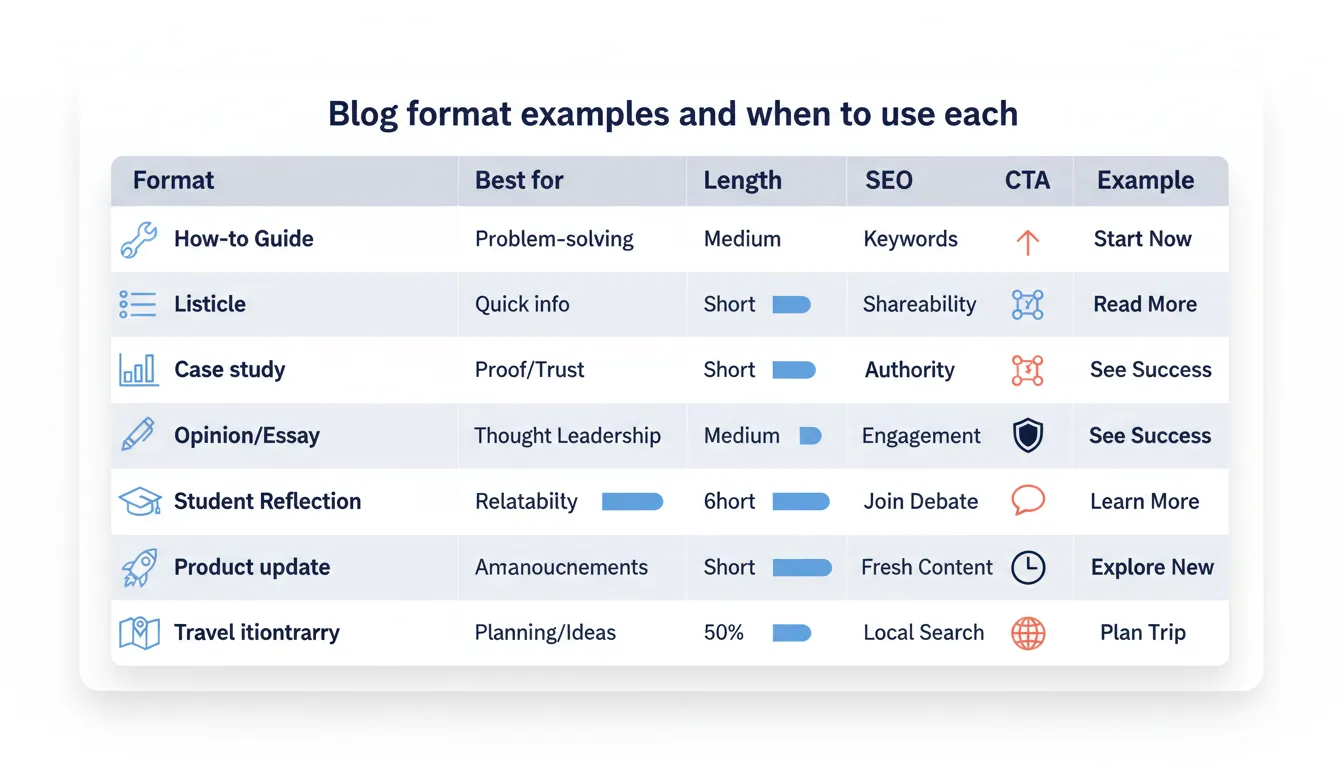
If you’re choosing a format quickly, use this decision table:
| Blog post format | Best for | Typical length | SEO advantage | Example CTA |
|---|---|---|---|---|
| How-to guide | Evergreen traffic | 1,200–3,000+ | Targets high-intent queries | “Get the checklist” |
| Listicle | Inspiration and choice | 1,000–2,500 | Captures “best X” searches | “Compare options” |
| Case study | Trust and leads | 1,200–2,500 | Earns links and conversions | “Book a demo” |
| Opinion/essay | Personal brand | 800–2,000 | Differentiates voice | “Reply or share” |
| Student reflection | Learning journals | 500–1,200 | Builds writing consistency | “Comment your take” |
| Product update/changelog | SaaS retention | 300–1,000 | Keeps site fresh | “Try the feature” |
| Travel itinerary | Travel bloggers | 1,500–4,000 | Long-tail destination keywords | “Download the map” |
12 blog examples to inspire your own blog
These examples show different ways to handle structure, positioning, and repeatable content patterns. Some are “best-of” roundups, some are platforms, and some are places to study layout and UX.
Supawriter
What it is: Supawriter is an AI-powered content engine built for teams that want consistent, rank-ready blog content without losing brand voice.
Key features:
- Long-form AI writing designed for 2,500+ word posts
- SEO optimization (keyword targeting, metadata support, internal linking workflows)
- Smart scheduling and content calendar support
- Research and fact-verification workflow (useful when you’re updating posts)
- CMS and publishing workflows, plus deployment to any website
Pros:
- Strong for scaling content while keeping structure consistent
- Helps teams move from “inspiration” to “publish” faster
Cons:
- If you only need a one-off personal post once a month, you may not use the full workflow depth
Best for: SaaS founders and growth teams who want to publish consistently, build topic authority, and convert readers into leads.
Pricing: Varies by plan and usage.
Wix Blog
What it is: Wix’s blog hub and inspiration content, including their roundup of 19 blog examples.
Key features:
- Clear list format with “key takeaways” per example
- Strong emphasis on design, navigation, and consistency
Pros:
- Beginner-friendly, good for design inspiration
Cons:
- Geared toward Wix users, so some tips are platform-specific
Best for: Beginners who want a fast sense of what great blog design looks like.
Siege Media
What it is: A content marketing agency’s breakdown of business blog examples and why they work.
Key features:
- Emphasis on conversion paths, navigation, and audience definition
- Includes supporting stats (for example, they cite that 81% of retail shoppers research online before buying). Siege Media’s business blog examples is a solid model for “examples + principles” content.
Pros:
- Useful if you care about leads, not just aesthetics
Cons:
- More business-focused than lifestyle or personal blogs
Best for: B2B and ecommerce teams building a blog to drive revenue.
Hostinger
What it is: A broad roundup of blog examples across many niches.
Key features:
- Large list across categories (tech, lifestyle, etc.)
Pros:
- Helpful for niche exploration when you haven’t picked a direction
Cons:
- Roundups can be light on deep teardown per example
Best for: New bloggers choosing a niche.
Squarespace
What it is: Curated blog website examples, often tied to templates.
Key features:
- Design-forward examples, layout ideas for modern blog pages
Pros:
- Strong for minimal, clean layouts
Cons:
- Less focused on SEO mechanics and content strategy
Best for: Creators who care about brand presentation.
Webflow
What it is: Older but still useful examples of blogs doing design well.
Key features:
- UX and layout inspiration
Pros:
- Great for layout patterns and page design ideas
Cons:
- Some examples may be dated
Best for: Designers and teams with Webflow-style design systems.
Semrush
What it is: A marketing-focused page on blog post examples and best practices.
Key features:
- Content marketing and SEO framing
Pros:
- Useful when you want examples tied to on-page best practices
Cons:
- Can lean tool-ecosystem heavy
Best for: Marketers who need posts that rank.
Jasper
What it is: A blog post about blog writing examples and what makes posts effective.
Key features:
- Shows examples and points out structural elements like subheadings, skimmability, and CTAs. Jasper’s blog writing examples is a clear example of example-driven teaching.
Pros:
- Helpful reminders on structure and readability
Cons:
- Not a “best blogs of 2026” list, it’s more about post construction
Best for: Writers learning how to structure posts that convert.
RyRob
What it is: A creator-style roundup of blog examples, often with monetization framing.
Key features:
- Breakdowns of niches and what makes them successful
Pros:
- Useful if you’re thinking about blog income models
Cons:
- May focus more on creator paths than enterprise content ops
Best for: Solo creators and side projects.
Pinterest Ideas
What it is: Visual inspiration for blog layouts, sections, and post styling.
Key features:
- A lot of visual patterns for headers, featured grids, and content blocks
Pros:
- Great for quickly collecting design ideas
Cons:
- Inspiration is fragmented, not always tied to performance
Best for: Design moodboarding.
Dribbble
What it is: Design galleries and UI inspiration, including blog page layouts.
Key features:
- High-quality UI patterns for blog home pages and article pages
Pros:
- Strong for modern layout components
Cons:
- Many are concepts, not working blogs with real content
Best for: Teams redesigning blog UX.
Reddit r/Blogging
What it is: Real bloggers sharing their sites, questions, and feedback.
Key features:
- Unfiltered “what my blog looks like” examples
Pros:
- You see real-world constraints, not polished marketing
Cons:
- Quality varies, not curated for best practices
Best for: Sanity checks and community learning.
How to use these blog examples without copying them
Looking at blog examples is useful, but copying them is a trap. Borrow the parts that work and rebuild them for your audience.
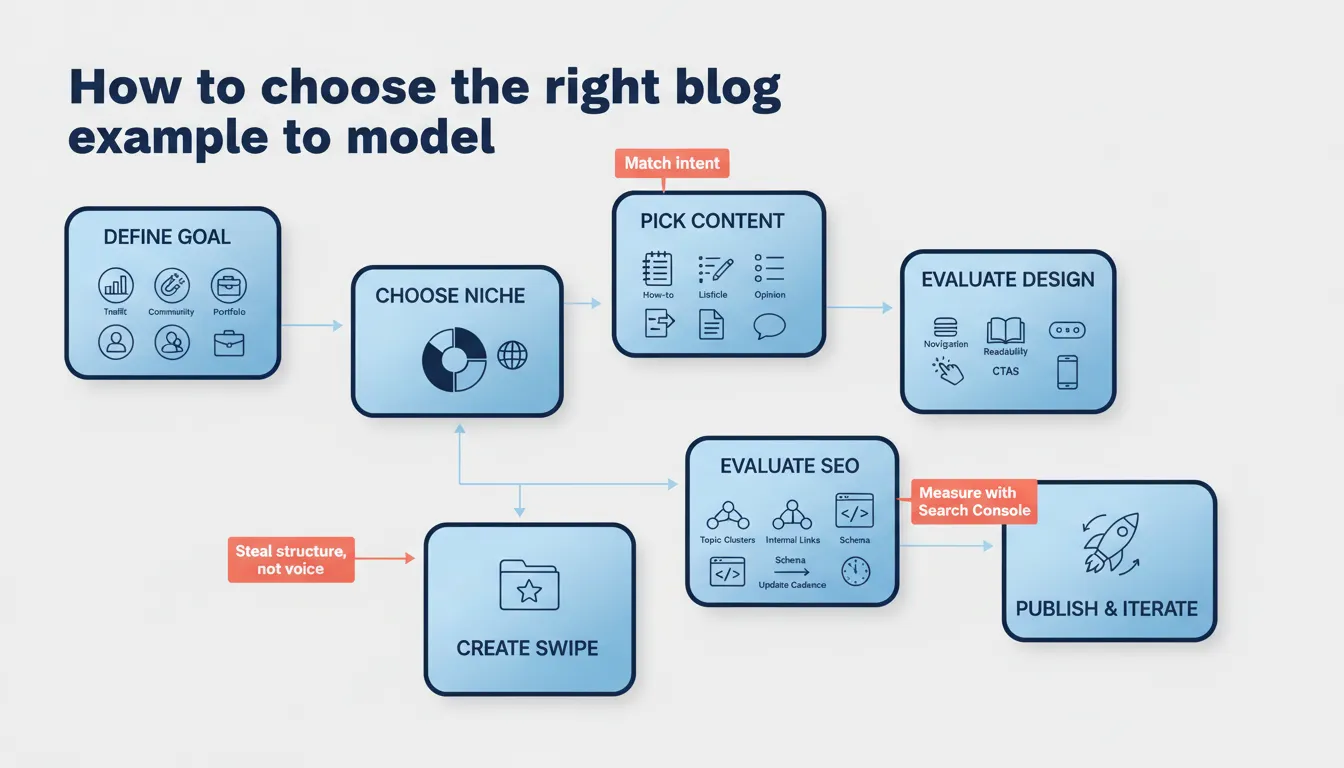
Build a swipe file by components
Instead of bookmarking full sites, collect reusable parts:
- Hero section patterns (headline + value prop)
- Category navigation and tagging
- Post intro formulas
- Image placement rhythm
- Internal linking blocks (“related posts”)
- CTA placements
Then label each component with the job it does, like “reduces bounce” or “drives signups.”
Turn one example into a repeatable system
Pick one blog example and rebuild it as a system:
- Define 3–5 core categories (your pillars)
- Map 10 supporting posts under each pillar
- Standardize your post templates by type (how-to, listicle, case study)
If you want a straightforward process for this, start from a documented content strategy framework and then convert it into a publishing plan with a content calendar.
Publish consistently with an AI-assisted workflow
Consistency is where most blogs fail, not ideas.
A steady cadence is easier with Supawriter because you can go from SERP-driven outline to draft to SEO polish in one workflow, then schedule content so your blog stays active. Pair that with a simple on-page process like this on-page SEO checklist to keep every post aligned.
EEAT visual: choose the right example to model
Blog examples for students and beginners (short samples)
If you want short blog examples you can model immediately, here are three original samples you can adapt.
Student reflection blog example (short)
Last week, I tried a new study method: I wrote one question at the top of a blank page before I opened my notes. The goal was to force my brain to search for an answer first, instead of copying definitions.
It worked better than I expected. I remembered more, but I also noticed a problem: I got stuck when my question was too big. Next time, I’ll start with smaller questions like “What is one example of this concept?”
My takeaway: learning improves when I make my confusion visible. If you’re studying too, try one question per session and track what changed.
Beginner personal blog example (short)
I used to think I needed a “perfect niche” before I could blog. What I actually needed was a repeatable way to publish.
So I picked three categories I can write about even on a busy week: (1) what I’m learning at work, (2) one tool I tested, and (3) one small habit I’m building. Now, when I don’t know what to write, I choose one category and write for 30 minutes.
It’s not fancy, but it’s real. And it’s finally consistent.
Simple travel blog example (short)
If you have one day in a city, plan your itinerary around two anchors: one neighborhood you can explore slowly and one “must-see” that’s worth the line.
For my last trip, I did a morning loop: coffee, a long walk, then a museum. In the afternoon, I picked one food spot and one viewpoint for sunset. The best part was leaving space between stops so the day didn’t feel rushed.
Save your exact addresses in one map list, then only commit to three fixed times: start, lunch, and sunset.
A blog gets good when it turns examples into action. If you want to build a blog that publishes consistently and stays optimized as your content library grows, explore Supawriter and use it to turn the best ideas you find into your own system.
Grow your traffic on autopilot now
Join thousands of users already using our platform.