AI Content Writer: Best Features and Uses in 2026
supawriter
If you are searching for an ai content writer, you are probably not looking for theory alone. You want a faster way to create blog posts, landing pages, email copy, social text, and SEO content without sacrificing quality. That is why this topic has strong commercial intent in 2026. Readers want a tool, a workflow, or a platform that helps them write, edit, optimize, and publish content efficiently.
At a basic level, an ai content writer is software that uses large language models to generate text from prompts, outlines, source material, or keyword inputs. But the best platforms do more than generate text. They help you research topics, match brand voice, optimize structure, insert internal links, and prepare content for publishing. When it comes to turning raw ideas into rank-ready articles, Supawriter offers a more complete path from research to live content than a standalone writing tool.
AI-assisted writing is now common in content teams. HubSpot's State of Blogging research says only 4% of bloggers report never using AI tools to support content creation, showing how widely these tools are used among marketers and publishers (HubSpot). According to Semrush Content Marketing Statistics, around 70 to 80% of businesses report benefits from AI in content marketing, and more than half use AI for tasks such as writing posts, though the exact percentages vary by survey year.
What an ai content writer does
How ai content writers generate drafts
An ai content writer turns your inputs into usable copy. Those inputs might be a short prompt, a keyword, a product description, a customer pain point, or a detailed content brief. The system generates text that fits the request, often with options for tone, length, format, and audience.
In practice, that means you can ask a tool to write a blog introduction, expand bullet points into paragraphs, rewrite awkward copy, generate headline ideas, or create multiple versions of a call to action. Some tools stop there. Others go further by helping you structure the article, identify missing subtopics, and shape the text around search intent.
That difference matters. A lightweight generator is useful for quick copy tasks, but a serious ai content writer should support the full writing process. If your team publishes regularly, it is worth reading this guide to SEO content and how to create it, because the best results come from combining AI writing with clear intent mapping and on-page structure.
Common content types you can create
Most ai writing tools can generate a wide range of content formats. Common examples include:
| Content type | How an ai content writer helps |
|---|---|
| Blog posts | Creates outlines, sections, meta descriptions, and full drafts |
| Landing pages | Writes benefit-driven copy, headlines, and FAQs |
| Product descriptions | Generates scalable, format-consistent text for catalogs |
| Email campaigns | Drafts subject lines, nurture sequences, and follow-ups |
| Social media copy | Produces captions, hooks, and repurposed snippets |
| Ad copy | Creates short-form variants for testing and iteration |
| Content briefs | Organizes target keyword, subtopics, and angle |
This flexibility explains why so many SERP results for this keyword are product pages. Searchers want a tool that can generate content fast, but they also want one that can adapt across channels.
Where ai writing helps most
AI writing is especially useful when speed, consistency, and output volume matter. It helps when you need to:
- turn rough ideas into a clean first draft
- scale blog production without increasing headcount at the same rate
- repurpose one article into email, social, and sales enablement copy
- keep tone and structure more consistent across multiple writers
- reduce time spent on repetitive writing tasks
Still, AI is not a substitute for judgment. It works best when paired with strategy, brand knowledge, editorial standards, and review.
How an ai content writer fits into your workflow
From keyword to first draft
The strongest results come from using an ai content writer as part of a repeatable workflow, not as a one-click article machine. A smart process usually starts with a keyword or topic, then moves into SERP analysis, content angle selection, outline creation, drafting, optimization, and review.
That workflow is also becoming more important because search itself is changing. Semrush reported that SERPs with ads plus AI Overviews grew by more than 394% in 2025, a reminder that content teams need sharper structure and stronger topical coverage to compete for visibility (Semrush).
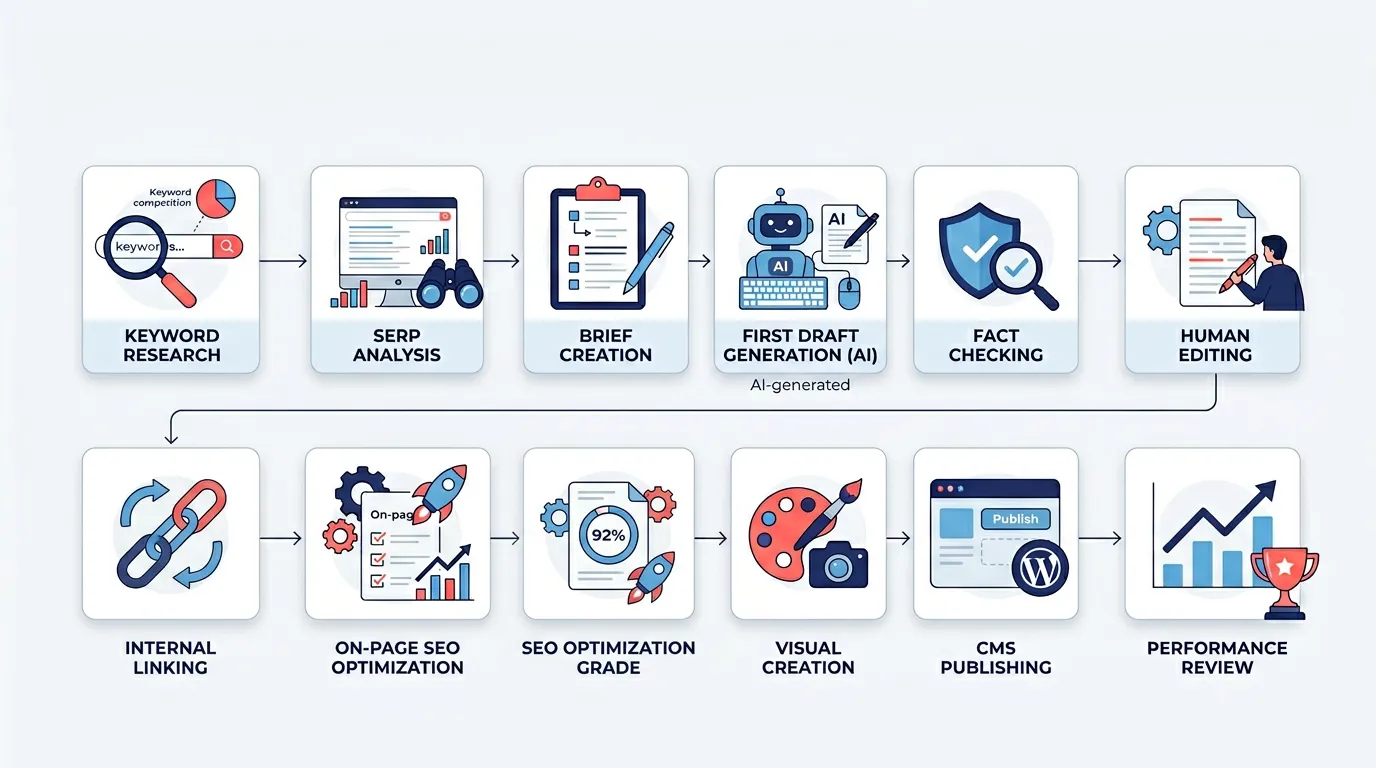
In a modern workflow, you start with the keyword, review what is already ranking, define the search intent, and create a brief that covers essential subtopics. Then the ai writer generates a structured draft. After that, a human editor checks claims, improves transitions, sharpens the point of view, and aligns the piece with your brand.
That workflow is easier with Supawriter, because it combines real-time SERP analysis, SEO optimization, internal linking, visuals, and publishing in one system instead of forcing you to stitch together separate tools.
Why human editing still matters
Even the best ai content writer can produce bland phrasing, overconfident claims, weak examples, or text that sounds polished but generic. That is why editing still matters.
Human review improves originality, accuracy, and differentiation. It also helps you add lived experience, customer context, and product knowledge that a general model may not know. For B2B and SaaS teams, those details often make the difference between content that ranks briefly and content that earns trust.
Editing is also where you fix the common issues people complain about with AI writing: repetitive sentence patterns, vague copy, surface-level insight, and unsupported statements. If your team wants a more reliable process, this article on the on-page SEO checklist for 2026 pairs well with AI-assisted drafting because it gives editors a consistent quality standard.
How SEO teams use ai at scale
SEO teams are using AI for much more than article generation. Semrush's 2026 job market study found that AI literacy is becoming a baseline expectation in content roles, while employers increasingly emphasize analytics, SEO, and measurable outcomes over writing alone (Semrush). That matches what many teams are seeing internally: the value is no longer just writing faster, but running a content engine with stronger throughput and clearer performance tracking.
In practice, teams use an ai content writer to create briefs, generate outlines, draft sections, test titles, build FAQs, repurpose content, and speed up refreshes on older pages. They also use AI to support content calendars and topic planning. If you are building that broader system, a practical next step is learning how to build a content calendar so publishing frequency and topic prioritization stay aligned.
Features that separate a basic ai writer from a serious content platform
Brand voice and long-form writing
A basic AI writer can produce text. A stronger ai content writer can produce text that sounds like your brand.
That means it should be able to reflect tone, preferred terminology, audience level, and structural patterns across long-form articles. This is especially important if your company publishes educational content, category pages, thought leadership, or demand-generation copy where consistency affects trust.
Long-form depth matters too. Many free tools are fine for short paragraphs but struggle when asked to produce a coherent 2,000-word article with strong transitions and a clear narrative. Supawriter lets teams create long-form content of 2,500 words or more while staying closer to brand voice, which is a meaningful step up from a generic generator.
SEO optimization and internal linking
A lot of AI tools can write. Fewer can help the content rank.
That is where SEO-focused features become important. A strong platform should help with keyword targeting, title tags, meta descriptions, heading structure, topical coverage, and internal linking opportunities. It should also help you see what is missing compared with pages already ranking for the keyword.
When an ai content writer includes internal link suggestions, it saves editors time and improves site structure. For example, if you are planning a larger SEO system, it is natural to connect this topic to how to build a content strategy or a guide on automating SEO workflows. Those connections help users and search engines understand the relationship between your pages.
Research, fact checking, and publishing
This is one of the biggest dividing lines in the market. Many tools are good at text generation but weak at verification and workflow. They may produce a polished draft, yet leave you to manually check facts, create visuals, and move the piece into your CMS.
A more serious platform helps with real-time research, fact verification, visual generation, and publishing. That reduces the risk of stale claims and shortens the time between draft and live page.
For lean teams, this matters a lot. Instead of passing an article across five tools and three people, you can keep the process tighter and easier to manage. For an end-to-end ai content writer, that operational advantage often matters as much as writing quality.
How to choose the best ai content writer for your team
Questions to ask before you buy
Before you choose a platform, ask practical questions that match your workflow:
| Question | Why it matters |
|---|---|
| Does it support long-form content? | Short-form tools may break down on full articles |
| Can it match brand voice? | Consistency improves trust and editing speed |
| Does it help with SEO? | Ranking requires more than fluent text |
| Can it verify claims or support research? | Accuracy matters for credibility |
| Does it suggest internal links? | Better site architecture and faster editing |
| Can it publish to your CMS? | Fewer steps mean less friction |
| Does it include visuals or image generation? | Helpful for engagement and completeness |
If you only need occasional social captions or headline ideas, a free AI content generator may be enough. But if you are responsible for organic growth, blog production, and publishing operations, you will usually need more than a simple writer.
Best fit for founders, marketers, and editors
Different teams need different things from an ai content writer.
Founders and small SaaS teams usually need speed and leverage. They want to turn expertise into blog posts without building a full editorial team. Growth marketers tend to care most about SEO alignment, internal links, and measurable traffic potential. Content leaders often focus on workflow control, voice consistency, approvals, and publishing.
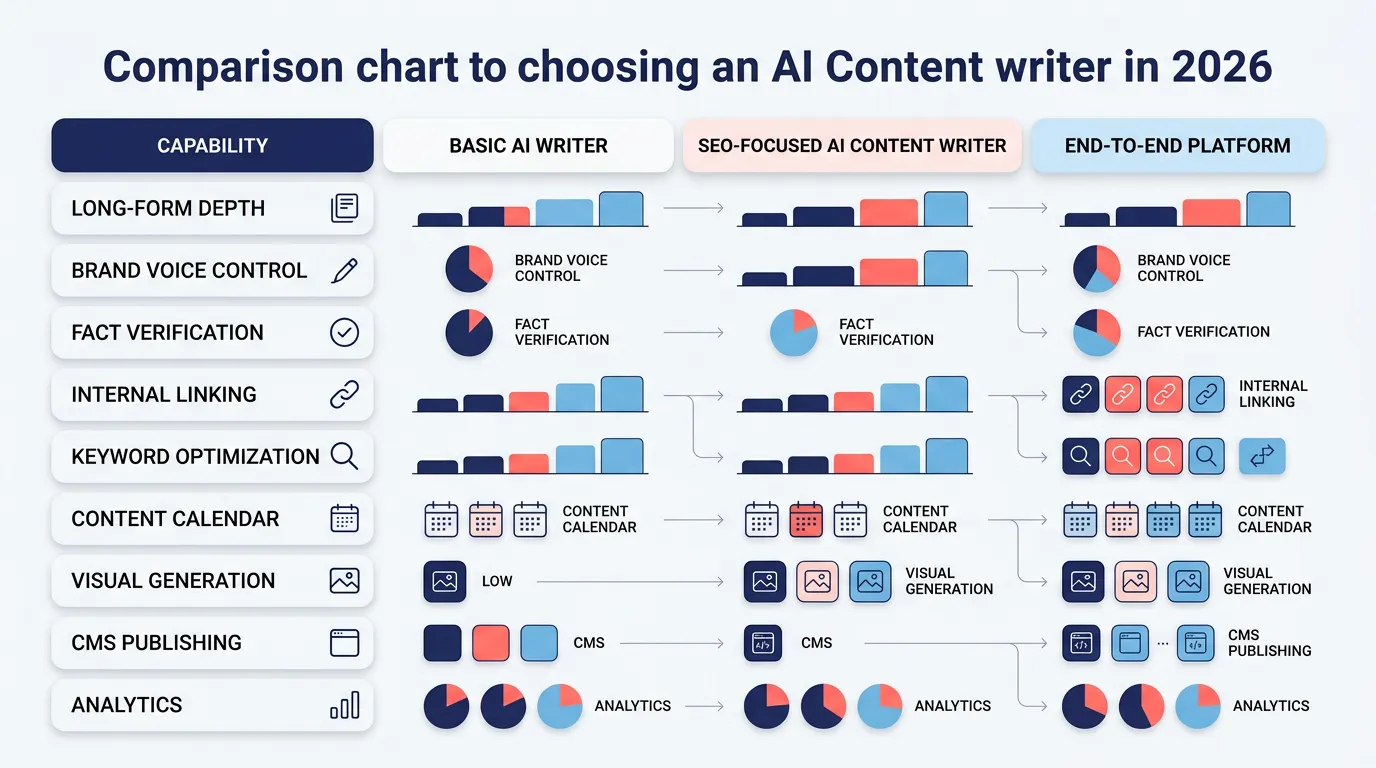
That is why the best choice is often not the flashiest generator. It is the platform that removes the most friction from your actual process. For teams that need keyword suggestions, writing, optimization, visuals, scheduling, and CMS support in one place, Supawriter is built for the job more directly than a standalone text tool.
Mistakes to avoid when comparing tools
A common mistake is comparing AI tools only by how quickly they generate text. Speed matters, but it is not the only metric.
You should also compare:
- output quality after light editing
- topical depth and structure
- SEO support
- factual reliability
- workflow fit
- publishing support
- ability to scale across multiple posts per month
Another mistake is assuming free tools and full platforms solve the same problem. They do not. A free generator can help you write a paragraph. A content platform should help you build a repeatable engine.
Is an ai content writer worth it in 2026
When free tools are enough
Free tools are often enough if your needs are narrow. Maybe you want help getting past writer's block, generating a rough outline, rewriting a paragraph, or creating a few versions of ad copy. In those cases, a lightweight AI writer can save time without requiring a full platform commitment.
They can also be useful for solo creators who already have a strong workflow and only need occasional drafting support.
When you need a platform like Supawriter
The equation changes when content is tied to growth targets. If your team needs articles that are long-form, optimized, internally linked, brand-aligned, visually complete, and ready to publish, then the writing model alone is not enough.
That is where Supawriter stands out. It combines AI writing, SEO optimization, content suggestions, smart scheduling, contextual visuals, CMS workflows, deployment to any website, real-time SERP analysis, and real-time fact verification. For startups and growth teams trying to scale content without expanding overhead at the same rate, that combination is more useful than juggling a separate generator, SEO tool, calendar, image app, and CMS.
What good ai content looks like
Good AI content does not read like it was produced by a machine. It feels clear, relevant, structured, and genuinely helpful. It answers the search intent, covers the needed subtopics, uses simple language, and reflects a real point of view.
It also fits into a larger strategy. Content Marketing Institute's 2025 B2B benchmarks note that many marketers are still experimenting with AI rather than fully embedding it into daily operations, which suggests there is still a competitive advantage for teams that use AI in a disciplined, process-driven way (Content Marketing Institute). In other words, the edge is no longer just using AI. The edge is using it well.
If you want an ai content writer that helps you move from idea to optimized, publish-ready content with less friction, explore Supawriter. It is a practical fit for teams that need more than generated text and want a system that supports the full content workflow in 2026.
Grow your traffic on autopilot now
Join thousands of users already using our platform.