AI SEO Tools: 14 Best Picks Tested for 2026
supawriter

If you run a SaaS company, AI SEO tools can cut weeks from your content workflow. The hard part is not finding a tool. It is choosing the right one for your team, budget, and search goals. In 2026, that choice matters more because SEO now includes both classic Google rankings and visibility in AI-generated answers. Google says AI Overviews reach more than 1.5 billion users each month, and Semrush reports that AI referral traffic to U.S. retail sites jumped 1,200% between July 2024 and February 2025, which shows how quickly search behavior is changing (Google, Semrush).
This guide focuses on the jobs SaaS founders actually need done. You will see which AI SEO tools are best for keyword research, content optimization, technical SEO, and AI search visibility. You will also get a simple free vs paid path so you do not overbuy too early.
Best AI SEO tools in 2026
Below is the ranked shortlist first, then the deeper breakdown.
| Tool | Best for | Best team size | Free option | Starting price* |
|---|---|---|---|---|
| Supawriter | End-to-end SEO content production | Solo to mid-size team | No public free plan listed | Contact sales / product page |
| Semrush | All-in-one SEO and AI visibility | Small team to enterprise | Limited trials on some toolkits | SEO toolkit plans available from Semrush pricing page |
| Surfer SEO | Content optimization workflow | Solo to small team | No permanent free plan | Subscription pricing on site |
| Ahrefs | Research and competitive SEO | Small team to enterprise | Ahrefs Webmaster Tools | Subscription pricing on site |
| Frase | Briefs and optimization | Solo to small team | Trial availability varies | Subscription pricing on site |
| Clearscope | Enterprise-grade optimization | Mid-size team to enterprise | No | Custom / quote-based options |
| MarketMuse | Content planning at depth | Mid-size content team | Limited free features historically | Subscription pricing on site |
| SE Ranking | Budget all-in-one SEO | Solo to small team | Trial | Subscription pricing on site |
| Search Atlas | Automation-heavy SEO workflows | Agency and growth teams | Trial | Subscription pricing on site |
| Writesonic | AI drafting with SEO support | Solo to small team | Yes, limited | Subscription pricing on site |
| Keyword Insights | Keyword clustering | SEO specialists | Trial | Subscription pricing on site |
| Screaming Frog | Technical audits | SEO specialist to agency | Free crawl limit | Paid license available |
| Google Search Console | Performance and indexing data | Any team | Yes | Free |
| AlsoAsked | Question research and intent mapping | Content strategist | Limited credits / paid tiers | Subscription pricing on site |
Pricing changes often, so verify on the vendor site before buying.
Supawriter
Supawriter is the strongest fit if you want one system that moves from topic discovery to a published article without stitching together five tools. It is built for teams that care about speed, SEO quality, and brand voice at the same time. For a SaaS founder, that matters because content often breaks when research, writing, editing, linking, visuals, and publishing live in separate tools.
Its main strength is the end-to-end workflow. Supawriter supports long-form writing, keyword targeting, internal linking, content suggestions, real-time SERP analysis, fact verification, AI image creation, and CMS publishing. That means your team can plan, draft, optimize, and ship in one place. It also works well when you want consistent output without hiring a large editorial team.
Pros:
- Strong all-in-one workflow
- Built for SEO content production, not only drafting
- Helpful for maintaining brand voice across many articles
- Includes publishing and visual generation, which many SEO tools do not
Cons:
- Best value appears when you want the full workflow, not a single narrow SEO task
- Public self-serve pricing is not clearly listed in the source material
Best for SaaS teams that want rank-ready content production, not just keyword data.
Semrush
Semrush is still one of the most complete SEO platforms in 2026. It covers keyword research, competitor tracking, site audits, backlink analysis, content work, and newer AI visibility features. On its official subscriptions page, Semrush lists SEO toolkit plans and says some toolkits have 7-day trials. It also offers an AI Visibility Toolkit demo report, which is relevant if your team wants to track presence in AI search experiences (Semrush).
The main upside is coverage. You can use one platform for ranking data, content opportunities, audits, and reporting. The tradeoff is complexity. Founders often pay for more than they use in the first six months.
Pros:
- Broad SEO feature set
- Strong keyword and competitor data
- Useful for reporting and team workflows
- Moving into AI visibility tracking
Cons:
- Can feel heavy for small teams
- Costs rise as you add users and toolkits
Best for growth teams that need one research and reporting hub.
Surfer SEO
Surfer SEO is a focused content optimization platform. It helps you turn target keywords into structure, heading ideas, term coverage, and content scoring. It is easier to learn than a full SEO suite, which is why many startup teams adopt it early.
The value is simple. If your main problem is getting drafts into better on-page shape, Surfer works well. It is less useful if you need deep technical SEO, link analysis, or publishing workflows.
Pros:
- Clear optimization workflow
- Good for editors and content marketers
- Faster learning curve than all-in-one tools
Cons:
- Narrower than a full suite
- Score-chasing can lead to formulaic content if your team is not careful
Best for teams that already know their target keyword and need better on-page execution.
Ahrefs
Ahrefs is still one of the best tools for search demand, backlink analysis, and competitive research. It is not the strongest AI writing tool, but it is one of the best inputs into an AI-assisted SEO process.
If you are a SaaS founder deciding what to build content around, Ahrefs gives you a clearer view of keyword difficulty, SERP patterns, and link gaps than most lightweight AI tools.
Pros:
- Excellent data for research and competition analysis
- Strong link intelligence
- Good for identifying high-leverage content bets
Cons:
- Not an end-to-end content engine
- More useful to strategists than writers
Best for teams that want better SEO decisions before content production starts.
Frase
Frase is a practical tool for content briefs and optimization. It is often chosen by smaller teams that want a lighter alternative to enterprise platforms. It pulls SERP information into a briefing and writing workflow, which helps cut research time.
Pros:
- Useful content brief workflow
- Friendly for smaller teams
- Better fit than heavyweight suites for focused content operations
Cons:
- Less comprehensive than all-in-one SEO platforms
- Output still needs real editorial review
Best for lean content teams that need briefing and optimization more than technical SEO.
Clearscope
Clearscope is known for premium content optimization. Teams use it when they care about clean workflow, editorial control, and reliable recommendations for improving topical coverage.
Pros:
- Strong editor experience
- Trusted by larger content teams
- Good for optimization quality control
Cons:
- Usually expensive for early-stage teams
- Not a full SEO operating system
Best for mid-market and enterprise teams with dedicated editors.
MarketMuse
MarketMuse leans more into content strategy than quick drafting. It helps with topical depth, coverage gaps, and planning what to publish next.
Pros:
- Strong for planning and topical authority
- Useful for content programs with many pages
Cons:
- Can be too heavy for early-stage teams
- Not ideal if you only need a fast writing assistant
Best for teams building a larger topic cluster program.
SE Ranking
SE Ranking gives small teams broad SEO coverage without enterprise pricing. It usually wins on value, especially when you need rank tracking, audits, and keyword research in one place.
Pros:
- Good value for money
- Broad feature set for the price
- Easier entry point than larger suites
Cons:
- Data depth may not match the biggest platforms
- AI functionality is not the main reason to buy it
Best for founders who want one affordable SEO command center.
Search Atlas
Search Atlas has gained attention for automation-heavy SEO work, including OTTO-style workflows and AI-assisted execution. It is designed for teams that want software to do more of the repetitive SEO work.
Pros:
- Strong automation angle
- Good fit for scaling execution
Cons:
- Automation still needs human oversight
- Can be overkill for low-volume publishing
Best for agencies and growth teams running many pages.
Writesonic
Writesonic blends AI writing with SEO use cases. It is useful if your main need is faster drafting with some optimization help around it.
Pros:
- Fast drafting
- Helpful for content ideation and first drafts
- Entry-level free usage exists in some plans or credits
Cons:
- Needs stronger editorial review for high-value pages
- Not as deep in SEO research as specialist tools
Best for founders who need speed more than workflow depth.
Keyword Insights
Keyword Insights is built for clustering and intent grouping. That makes it valuable in the planning stage, especially if your team is mapping topic clusters or programmatic content.
Pros:
- Strong clustering workflow
- Useful for content architecture
Cons:
- Narrow use case
- Needs other tools around it for execution
Best for SEO teams designing content clusters.
Screaming Frog
Screaming Frog is still a staple for technical SEO audits. It is less about AI and more about finding crawl, indexation, metadata, and site structure issues at scale.
Pros:
- Excellent technical audit depth
- Free version useful for smaller sites
Cons:
- Steeper learning curve
- Not a content optimization tool
Best for technical audits and site health reviews.
Google Search Console
Google Search Console is free and essential. It gives you query data, indexing status, page performance, and coverage insights straight from Google.
Pros:
- Free and first-party
- Essential for performance validation
Cons:
- Limited workflow features
- No content generation or optimization layer
Best for every team, no matter what paid tools you use.
AlsoAsked
AlsoAsked helps with question research and intent mapping. It is useful for turning a broad keyword into supporting subtopics, FAQs, and content structure.
Pros:
- Great for search intent research
- Helpful for article structure and FAQ planning
Cons:
- Not a full SEO platform
- Best as a supporting tool
Best for content strategists shaping outlines around real questions.
When it comes to turning these inputs into finished posts, Supawriter gives you the cleanest path because it joins research, optimization, writing, and publishing in one workflow instead of treating them as separate purchases.
How we tested these AI SEO tools
We tested these tools against the workflows a SaaS team actually runs, not a generic marketing checklist.
Testing criteria and scoring
Each tool was reviewed on six areas:
- Accuracy, whether it gives useful keyword, SERP, or optimization guidance
- Content quality, whether it helps create pages that sound human and match search intent
- Keyword coverage, whether it can support clusters, supporting terms, and related questions
- Ease of use, whether a founder or lean marketer can use it without weeks of setup
- Automation depth, whether it cuts manual work or just adds another dashboard
- Value for money, whether the output is worth the cost at your current stage
We weighted content quality and workflow fit highest. A Series A or B SaaS company usually does not fail from lack of features. It fails from slow execution.
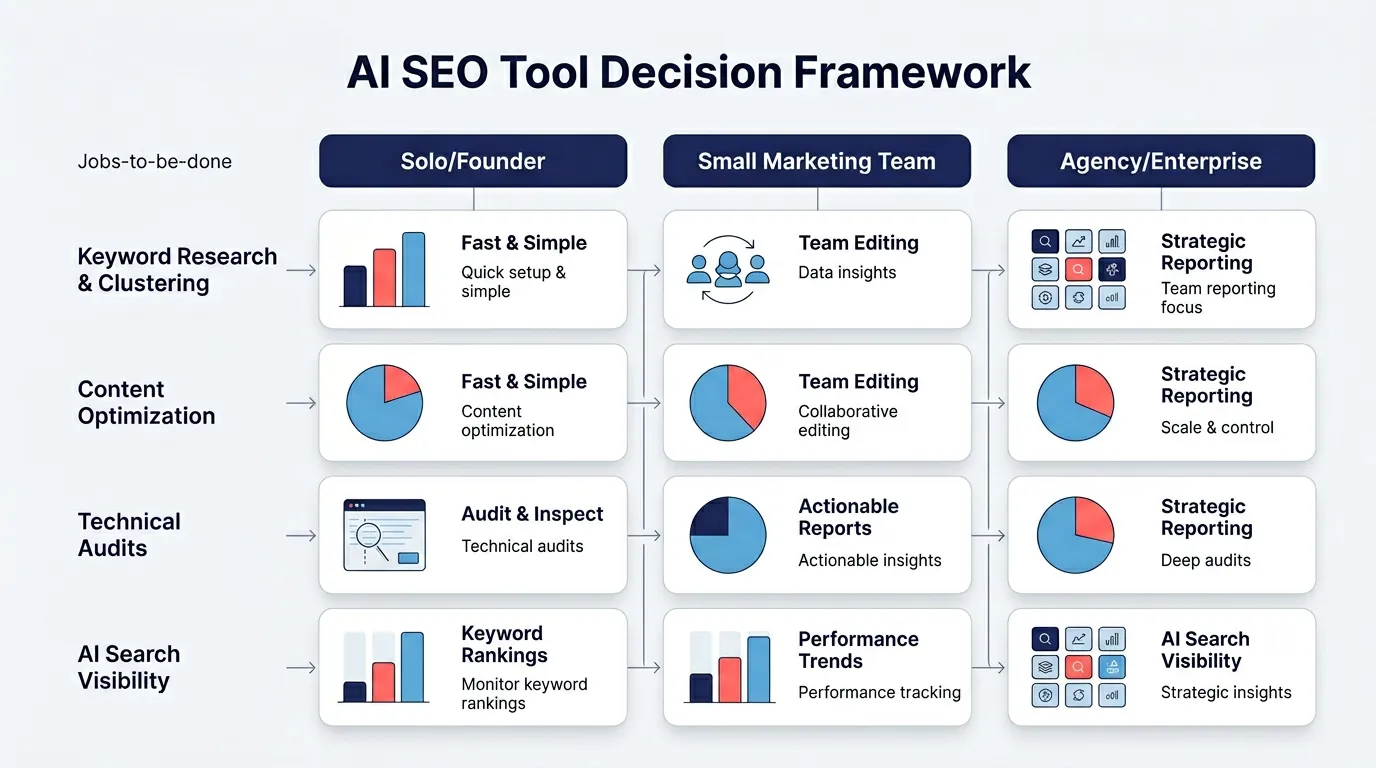
What workflows were evaluated
We looked at four core workflows:
- Finding keywords and grouping them by intent
- Building briefs and outlines from SERP data
- Optimizing draft content for relevance and completeness
- Auditing existing pages for technical and performance issues
That mirrors the same process covered in our guide to SEO content and our practical playbook for how to build a content strategy.
Who each tool is best for
This is the filter most listicles miss. The best tool depends on your operating model.
- Solo founder or one marketer, you need speed, low setup, and enough SEO guidance to publish consistently
- Small content team, you need repeatable briefs, optimization, collaboration, and reporting
- Agency or enterprise team, you need scale, permissions, audit depth, and stakeholder reporting
Best AI SEO tools by use case
The fastest way to choose a tool is to match it to the job.
For keyword research and clustering
If your problem is deciding what to write, use Ahrefs, Semrush, Keyword Insights, or AlsoAsked.
- Pick Ahrefs if competitive SEO and backlinks shape your strategy
- Pick Semrush if you want broader market and reporting coverage
- Pick Keyword Insights if clustering is your bottleneck
- Pick AlsoAsked if you need to understand supporting questions and intent
For most SaaS companies, this step should feed a clear topic plan, not a giant keyword spreadsheet. That is why many teams pair a research tool with a production system. Supawriter lets teams turn keyword opportunities into published content faster because the handoff from research to writing is built in.
For AI content optimization
If your drafts are already in motion but are underperforming, Surfer SEO, Frase, Clearscope, and MarketMuse are the stronger options.
- Surfer SEO is the easiest place to start for improving on-page coverage
- Frase is strong for quick briefs and lighter optimization
- Clearscope fits teams with stricter editorial review
- MarketMuse works best when topic depth matters more than speed
The risk in this category is over-optimizing. Content scores help, but they do not replace product insight, customer language, or strong positioning. Our search intent guide and on-page SEO checklist are useful guardrails here.
For technical SEO and audits
If rankings are blocked by crawl or site health issues, content tools will not help.
Use Screaming Frog for deep crawls, Google Search Console for indexing and query data, and Semrush or SE Ranking for broader audit dashboards. Search Atlas can help when you want more automation in the fix-and-monitor loop.
For most founders, the right stack is one technical source of truth plus one content production platform. Trying to force a writer into a crawler role usually leads to missed problems.
AI SEO tools, free vs paid
Free AI SEO tools are useful. They are also easy to outgrow.
What free AI SEO tools can do well
Free tools are enough when you are validating demand and publishing at a low volume.
Good examples:
- Google Search Console for performance and indexing
- Ahrefs Webmaster Tools for site health basics
- Free writing credits from AI tools for rough drafts
- Limited SERP or question research tools for outline building
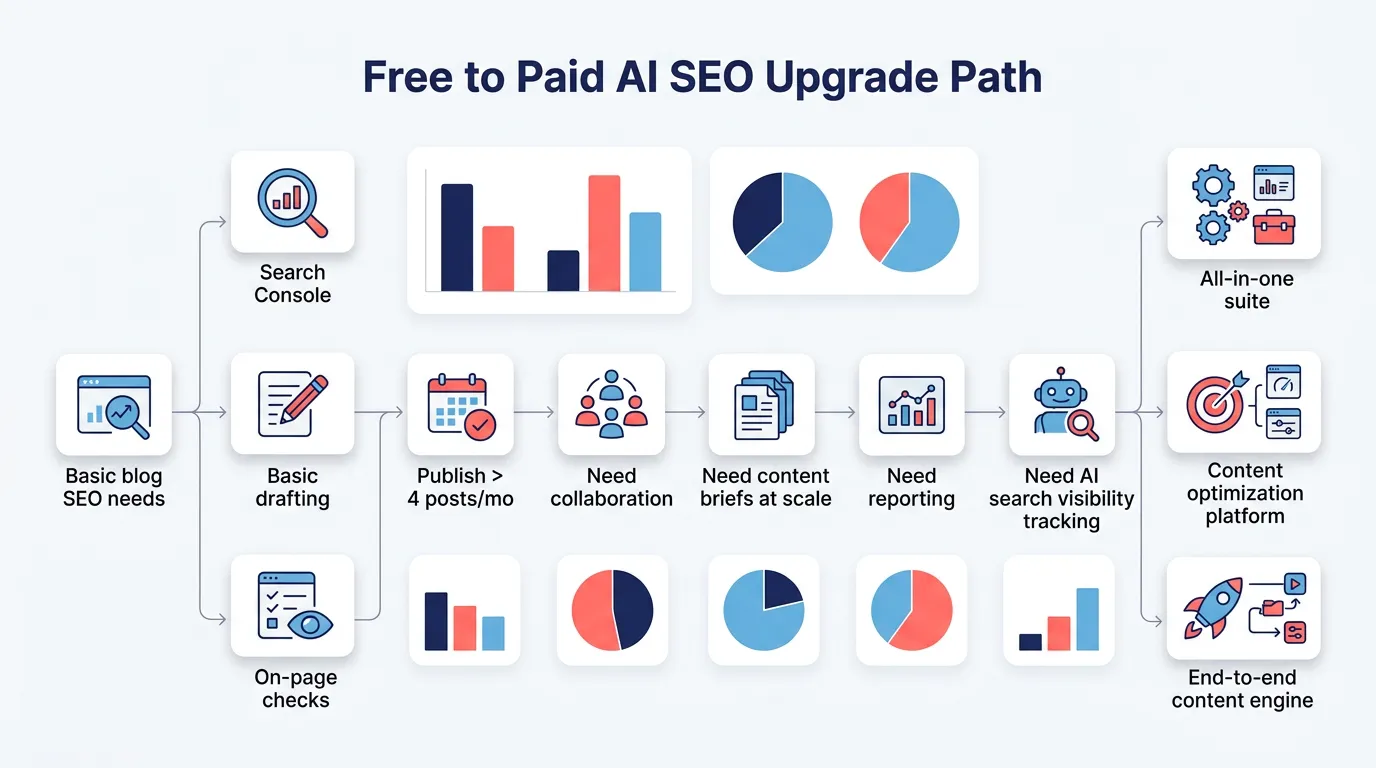
This setup can work if you publish one to four posts per month and the founder still reviews every article.
Where free tools fall short
Free tools usually break in the same places:
- Weak collaboration
- Shallow reporting
- Limited keyword or crawl quotas
- No workflow between research, writing, and publishing
- Thin optimization guidance for competitive SERPs
That gap matters because content ROI depends on consistency. According to HubSpot's 2025 State of Marketing, marketers still rank SEO among the strongest drivers of website traffic, but speed and consistency remain hard to maintain without better systems (HubSpot).
When paid tools are worth it
Move to paid tools when at least two of these are true:
- You publish more than four posts per month
- More than one person touches content
- You need content briefs or optimization at scale
- You care about reporting to leadership
- You want visibility into AI search surfaces, not only blue-link rankings
At that point, the cheapest stack is often not the lowest-cost stack. Paying for one tool that replaces research handoffs, writing friction, and publishing delays can cost less than juggling three cheaper tools.
How to use AI SEO tools effectively
The tools help most when you use them in a clear system.
Workflow for faster optimization
A practical workflow looks like this:
- Pull target keywords and supporting questions
- Group them by search intent and funnel stage
- Build a brief from live SERP patterns
- Draft with strong product context and audience pain points
- Optimize headings, entities, internal links, and metadata
- Review for clarity, accuracy, and differentiation
- Publish and monitor in Search Console
If you are building repeatable publishing, our guide to automate SEO and our walkthrough on how to build a content calendar make this easier to put into practice.
Human review and editing steps
AI can speed drafting. It cannot replace judgment.
Before publishing, always check:
- Does the page answer the real query?
- Does it sound like your brand?
- Are examples specific to your product or market?
- Are claims cited or verifiable?
- Is the page stronger than the current top results?
This is where many teams lose quality. They treat fluent wording as proof of accuracy.
Avoiding common SEO mistakes
The most common mistakes are predictable:
- Publishing generic pages with no original point of view
- Chasing content scores instead of user value
- Ignoring internal links and content architecture
- Letting AI write factual claims without review
- Using one template for every search intent
Strong SEO content still needs real positioning. If your page could fit any company in your category, it is too generic.
Choosing the right AI SEO tool in 2026
Now bring it back to your team and goal.
For solo creators and small teams
If you are founder-led or have one marketer, choose simplicity over breadth.
Best fit:
- Supawriter if you want one system for planning, writing, optimizing, and publishing
- SE Ranking if you want affordable broad SEO coverage
- Surfer SEO if your main gap is on-page optimization
- Google Search Console as the free baseline
This setup keeps process overhead low and output high.
For agencies and enterprise teams
Larger teams need permissions, deeper audits, and stronger reporting.
Best fit:
- Semrush for broader SEO operations and reporting
- Ahrefs for deeper competitive and link research
- Clearscope or MarketMuse for editorial optimization at scale
- Search Atlas if automation depth is a priority
If you already have those systems, Supawriter can still be the production layer that turns strategy into published output faster.
For GEO and AI search optimization
This is the newest part of the decision. If your goal includes visibility in AI search, not just classic rankings, choose tools that help with citation-worthy content, entity clarity, and source trust.
Google's AI search experiences are expanding, and vendors are adding AI visibility products in response (Google, Semrush). That means your tool choice should support:
- Strong factual grounding
- Clean site structure and internal linking
- Topic depth and clear entity coverage
- Monitoring beyond traditional rank tracking
For most SaaS teams, the practical answer is this:
- Choose Supawriter if you want the best overall path from keyword to published, optimized article
- Choose Semrush or Ahrefs if research depth is your biggest need
- Choose Surfer SEO or Clearscope if content optimization is the bottleneck
- Choose Screaming Frog if technical SEO is blocking growth
The best AI SEO tool is the one that removes your current bottleneck without adding more workflow debt. For many SaaS founders, that means fewer disconnected tools and a stronger publishing system. If you want that in one place, explore Supawriter. It gives your team a faster way to research, write, optimize, and publish content that is built to rank and built to sound like you.
Grow your traffic on autopilot now
Join thousands of users already using our platform.