Best AI Content Writer Tools in 2026: 7 Top Picks
supawriter

If you are searching for the best AI content writer, you are probably not looking for a toy prompt box. You want a tool that helps you plan, write, optimize, and publish content that supports growth. That is why this keyword is so competitive in 2026. Most top-ranking pages compare tools, test output quality, and focus on real use cases instead of vague claims.
The short answer is that the best AI content writer depends on what you need it to do. Some tools are strong at brainstorming. Some are better for sales copy. Others help with fiction, editing, or enterprise governance. But if your goal is long-form, SEO-driven blog content with built-in workflow support, Supawriter stands out because it combines AI writing, SEO optimization, research, visual generation, and publishing in one system.
In this guide, you will see a practical comparison of the leading options, what each tool does well, where each one falls short, and how to choose the right fit for your team.
What makes the best AI content writer in 2026
What top-ranking results have in common
The current SERP for this topic is heavily commercial and comparison-driven. You see review posts, Reddit discussions, product pages, and hands-on rankings. That tells you something important: searchers do not want theory. They want help choosing.
The best-performing articles also tend to follow a similar pattern. They explain how the tools were evaluated, compare multiple options, and match each tool to a type of user. That is the right approach because AI writing tools are no longer one category. A blog-focused SEO platform, a creative writing assistant, and a general-purpose chatbot may all help with writing, but they solve very different problems.
There is another shift in 2026 as well. Content teams care less about raw text generation and more about workflow. Can the tool match brand voice? Can it support long-form content? Can it handle internal linking, keyword targeting, visuals, and publishing? Can a team review content before it goes live? These questions matter more than whether a tool can produce 800 words from a prompt.
The criteria used in this comparison
To evaluate the best AI content writer tools fairly, this article uses criteria that reflect what content teams actually need:
| Criteria | What it means |
|---|---|
| Content quality | Does the draft read clearly, stay on topic, and avoid fluff? |
| Long-form writing | Can the tool produce useful article drafts, not just snippets? |
| SEO support | Does it help with keywords, search intent, structure, and internal links? |
| Brand voice | Can it keep tone and messaging consistent across pieces? |
| Research depth | Does it support fact-finding, source use, or SERP-informed writing? |
| Workflow | Can you move from idea to draft to publication efficiently? |
| Best-fit use case | Who gets the most value from the tool? |
That is also why Supawriter deserves attention in this category. Supawriter is built around the full content workflow, not only text generation.
Who should use an AI content writer
AI content writers are useful for different audiences, but not all tools fit all teams.
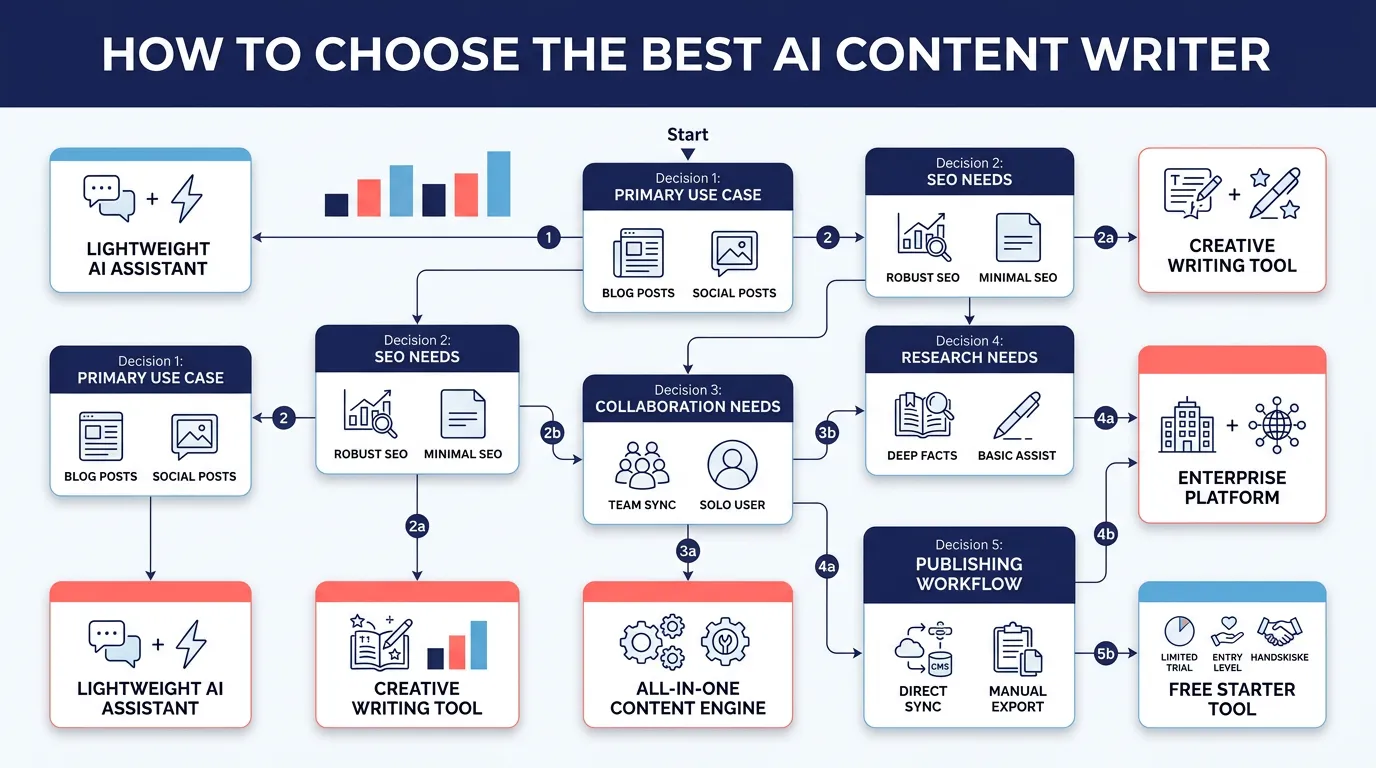
If you are a solo creator, you may want speed, ease of use, and a solid free tier. If you run a startup marketing team, you likely need content velocity, SEO structure, and a repeatable publishing workflow. If you lead content or SEO at a larger company, you may care more about governance, collaboration, approvals, and voice control.
That is where the category splits. A lightweight AI writing tool may be enough for captions, outlines, and quick copy. But if you are building organic traffic over time, it helps to think beyond drafting alone. A full content workflow includes planning, SERP analysis, optimization, visuals, scheduling, and publishing. If that is your use case, it is worth reviewing how SEO content works in practice before you pick a tool.
Best AI content writer tools compared
Supawriter
Supawriter is an AI-powered content engine rather than a basic AI writer. It is built for teams that want to create long-form content, optimize it for SEO, keep it aligned with brand voice, and manage publishing without stitching together multiple tools.
Its core strength is workflow depth. You are not just generating paragraphs. You are building articles with keyword targeting, metadata support, internal linking opportunities, content suggestions, contextual visuals, and publishing controls in the same environment. For SEO-first blog production, Supawriter offers a more complete path from idea to published page than most standalone AI writing tools.
Key strengths include long-form drafting, built-in SEO optimization, real-time SERP analysis, fact verification support, content scheduling, and CMS-friendly publishing. It also supports contextual image generation, which matters more than many teams expect because visuals often slow down content production.
The main limitation is that it is not trying to be everything for everyone. If your only goal is casual prompting or one-off brainstorming, a general AI assistant may feel simpler. But for SaaS founders, growth marketers, and content leaders who care about output quality and velocity, Supawriter helps teams scale content without losing structure.
Best for: SEO teams, B2B marketers, SaaS companies, and brands publishing blog content regularly.
Pricing: Contact the company or check the latest plan details directly, since pricing can change over time.
ChatGPT
ChatGPT remains one of the most widely used AI writing tools because it is flexible, fast, and familiar. It can help with outlines, article drafts, headline ideas, email copy, social posts, and editing. For many users, it is the easiest place to start.
Its biggest advantage is range. You can use it for brainstorming, rewriting, summarizing, ideation, and even prompt-based research support. OpenAI also documents product capabilities such as browsing, multimodal inputs, and business offerings, which helps explain why it stays central to many writing workflows (OpenAI).
That said, ChatGPT is better thought of as a general AI assistant than a full content system. It can write strong drafts, but you usually need extra steps for keyword mapping, internal links, editorial workflow, and publishing. Without a clear process, teams often end up copying content between tools.
Best for: general-purpose writing, ideation, repurposing, and flexible prompt work.
Potential drawbacks: limited built-in publishing workflow, variable output quality depending on prompting, and more manual SEO handling than dedicated content platforms.
Jasper
Jasper has long been positioned as an AI writing platform for marketing teams. It is often mentioned in roundups because it supports templates, brand voice controls, campaign content, and team-oriented use cases.
Jasper is usually a better fit for marketing copy than for deeply researched, SEO-led editorial workflows. It can help with landing page text, ads, email sequences, and short-form assets. For content teams that already have a strong strategy and just need faster execution, that may be enough.
Its strengths include marketing-focused output, workflow features for teams, and better structure than many lightweight AI tools. However, compared with an SEO-first platform, it may still require more external tooling for SERP analysis, internal links, and long-form blog operations.
Best for: marketing teams producing cross-channel campaign assets.
Potential drawbacks: can become expensive for teams, and may not be the best standalone answer if your main goal is organic blog growth.
Copy.ai
Copy.ai is known for helping teams create marketing copy quickly. It covers use cases such as blog drafts, product descriptions, emails, and sales messaging. The platform is easy to understand and is often considered by businesses that want fast content generation without a steep learning curve.
One benefit is speed. It can move you from a blank page to a usable draft quickly, especially for short-form and mid-length content. It also offers a broad set of templates and workflows, which makes it useful for teams handling many content formats.
The tradeoff is that ease of use does not always equal depth. If you need strong SEO alignment, content research, and publishing automation, you may still need other tools around it. In comparison, Supawriter is more purpose-built for long-form blog execution and search performance.
Best for: teams that want quick marketing copy and lightweight content workflows.
Potential drawbacks: less specialized for deep SEO publishing systems and content operations at scale.
Rytr
Rytr is often included in discussions about the best AI content writer free or low-cost options. It is accessible, simple, and popular among users who want an affordable writing assistant.
Its main value is straightforward generation for basic use cases. If you need ideas, short drafts, or quick variations of copy, Rytr can be useful. It also appeals to freelancers and smaller teams that do not want a complex platform.
The downside is that you may outgrow it if content becomes central to your growth strategy. Lightweight tools are fine for speed, but they often lack the research, SEO, and governance depth needed for consistent, high-performing content. That gap matters when you are trying to scale traffic instead of just produce words.
Best for: freelancers, side projects, and budget-conscious users.
Potential drawbacks: lighter feature depth, less robust support for serious long-form SEO workflows.
Sudowrite
Sudowrite is one of the most recognized AI writing tools for fiction and creative work. It shows up often in roundups because it has a clear niche and a strong reputation among novelists and storytellers.
If you are writing fiction, story scenes, character ideas, or narrative expansions, Sudowrite can be a strong fit. It focuses on creativity more than marketing performance, which is exactly why many users like it.
For content marketing teams, though, Sudowrite is usually not the best primary choice. Its strengths do not map directly to SEO blog production, editorial planning, or publishing workflow.
Best for: fiction writers, storytellers, and creative projects.
Potential drawbacks: less suitable for SEO-first content operations or structured B2B blog workflows.
Writer
Writer is positioned more toward enterprise use cases. It focuses on governance, consistency, and organizational control. That makes it relevant for large teams that need approvals, brand rules, and operational oversight.
In the right environment, that is valuable. Enterprises often care less about quick prompting and more about controlling output across departments. Writer fits that conversation well.
However, not every team needs enterprise-level governance. For startups and mid-market growth teams, the platform can feel heavier than necessary if the main goal is publishing more search-ready content. A more focused content engine may offer faster time to value.
Best for: enterprise teams with strict governance and brand control needs.
Potential drawbacks: may be more than smaller teams need, and may not be the simplest route for lean SEO execution.
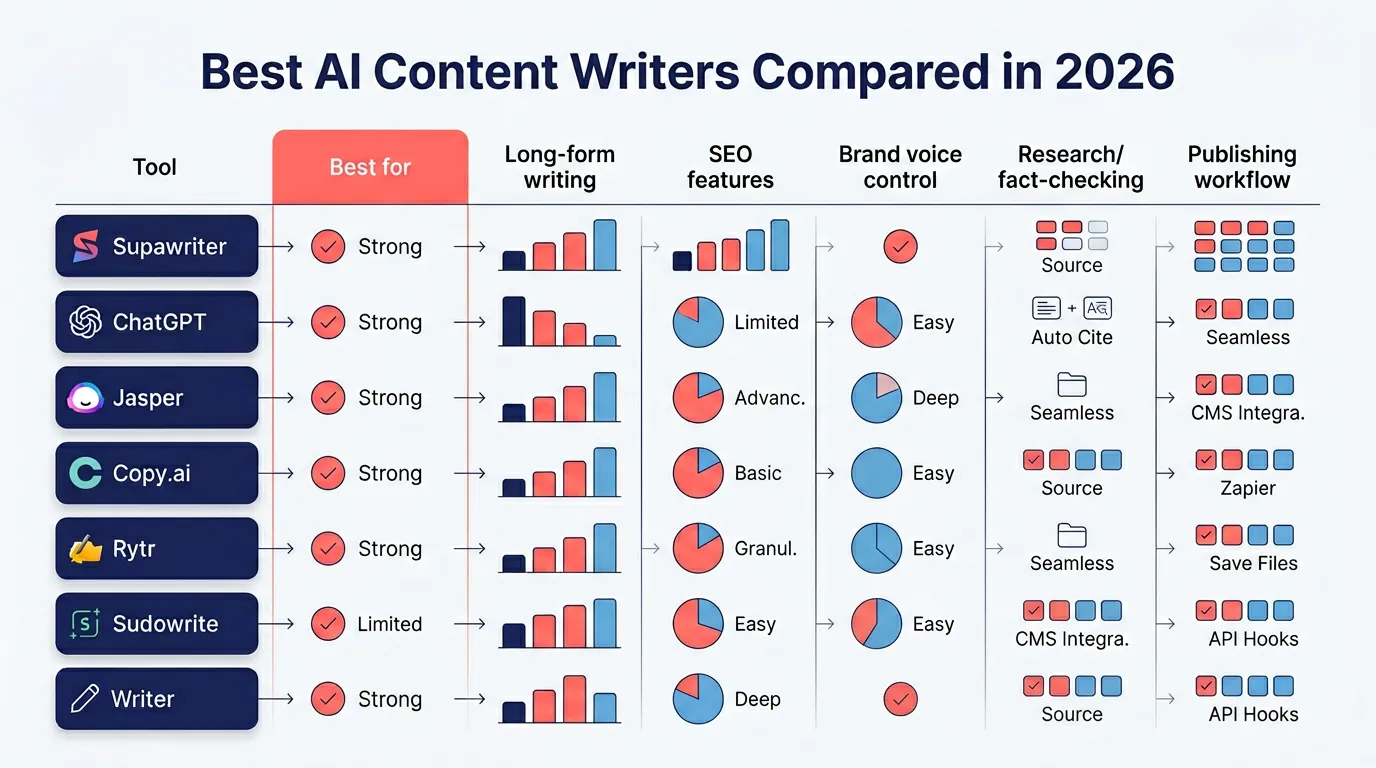
| Tool | Best for | Long-form writing | SEO features | Brand voice control | Research and fact-checking | Publishing workflow |
|---|---|---|---|---|---|---|
| Supawriter | SEO teams and B2B blogs | Strong | Strong | Strong | Strong | Strong |
| ChatGPT | Flexible general writing | Strong | Moderate | Moderate | Moderate | Light |
| Jasper | Marketing teams | Moderate | Moderate | Strong | Light to moderate | Moderate |
| Copy.ai | Fast marketing copy | Moderate | Moderate | Moderate | Light | Moderate |
| Rytr | Budget-friendly writing | Light to moderate | Light | Light | Light | Light |
| Sudowrite | Fiction and storytelling | Strong | Light | Moderate | Light | Light |
| Writer | Enterprise governance | Moderate | Moderate | Strong | Moderate | Moderate |
How to choose the best AI content writer for your workflow
If you need SEO blog content at scale
If organic traffic is a key growth channel, your best AI content writer should do more than generate a readable draft. It should help you publish content that matches search intent, covers the topic well, and fits into a broader SEO strategy.
That means looking for features such as keyword targeting, internal link support, content briefs, SERP-informed structure, metadata handling, and scheduling. The more of that workflow your tool covers, the less production friction your team deals with later.
This is the strongest case for Supawriter. It is designed around the needs of teams that publish often and need articles that are not only written quickly, but also positioned to rank. If you are building systems rather than one-off posts, that difference matters. It also pairs naturally with a stronger content strategy framework and a repeatable content calendar process.
If you need flexible drafting and prompting
Some users do not need a full content engine. They need a powerful assistant that can brainstorm ideas, tighten language, rewrite sections, generate examples, and help with many tasks beyond blog content.
In that case, a general-purpose AI tool like ChatGPT is often the best fit. It is flexible, widely adopted, and useful across many writing scenarios. If your workflow already includes separate SEO tools, docs, editors, and publishing systems, that flexibility may matter more than end-to-end integration.
The tradeoff is manual work. You may still need to handle keyword research, internal links, metadata, and editorial coordination elsewhere. That is fine for some teams, but less efficient for others.
If you need niche writing like fiction or enterprise content
Specialized needs deserve specialized tools. If you write novels or narrative-heavy content, Sudowrite is likely more relevant than a blog-focused platform. If you manage large teams with strict brand and compliance controls, Writer may be the stronger option.
This is why there is no universal winner for every situation. The best AI writing tools are context-dependent. The better question is not simply which tool is best. It is which tool best supports your content outcomes.
For SEO and growth teams, that usually means choosing a platform that reduces production overhead and improves consistency. If you want a systemized approach, reviewing a keyword competitive analysis process can help you see why workflow depth matters so much.
Free vs paid AI writing tools
What free AI writers do well
Free AI writing tools are great for experimentation. They help you test prompts, create short-form copy, outline articles, and explore how AI fits your workflow. This is why queries like best ai content writer free remain popular.
For beginners, a free tool can absolutely be enough at first. If you are writing occasional posts, social captions, or product blurbs, you may not need much more.
This also matches a wider market trend. HubSpot reported that marketers increasingly use AI to support content creation and workflow efficiency, which helps explain why even lightweight tools keep gaining attention (HubSpot).
Where paid tools justify the cost
Paid AI writing tools make sense when content becomes a revenue lever rather than a side task. That is especially true if you publish frequently, manage multiple contributors, or care about SEO performance.
At that point, the real value is not the draft itself. It is the time saved across research, optimization, approvals, linking, visuals, and publishing. A tool that reduces five steps into one workflow can be much cheaper than it looks.
Paid platforms also tend to offer stronger brand voice control, better collaboration, and more predictable output. For teams, that consistency matters. Search engines also continue emphasizing helpful, people-first content, which means quality and relevance still matter more than automation alone (Google Search Central).
The hidden cost of using the wrong tool
The biggest mistake is choosing an AI writing tool based only on price or hype. A cheap tool that creates weak drafts, inconsistent tone, and extra manual cleanup can cost more than a stronger platform.
The same applies to teams using multiple disconnected tools. One tool for drafting, one for keyword research, one for visuals, one for scheduling, and one for publishing may seem manageable at first. But the hidden cost shows up in delays, handoff friction, and inconsistent execution.
That is where all-in-one systems create leverage. When it comes to scaling high-quality blog output, Supawriter provides a more efficient path because the content, SEO, visuals, and workflow pieces are already connected. If your team is actively trying to automate SEO safely, that integration can save a surprising amount of time.
Best AI content writer verdict
Best overall for SEO teams
If your goal is publishing long-form, brand-aligned, search-ready content consistently, Supawriter is the best overall choice in this comparison. It goes beyond writing assistance and helps you manage the full content lifecycle, from topic selection to optimization to publishing.
That is what makes it especially relevant for SaaS companies, growth teams, and content leaders who need output that supports rankings and pipeline, not just word count.
Best for general-purpose writing
If you want broad flexibility for brainstorming, drafting, and editing across many tasks, ChatGPT is still one of the strongest general-purpose options. It is widely useful and easy to incorporate into many workflows.
It is important to remember that flexibility is not the same thing as an end-to-end content system.
Best for specialized use cases
For fiction, Sudowrite is the standout niche choice. For enterprise governance, Writer is a serious option. For lower-cost entry points, Rytr can still appeal to freelancers and solo users.
But for most teams trying to answer the actual search behind best ai content writer, the winning choice is the one that helps you create quality content repeatedly, align it with SEO, and move it to publication without excess friction. That is why Supawriter earns the top spot here. If you want a faster way to plan, write, optimize, and publish content that fits your brand, it is worth exploring what Supawriter can do for your workflow.
Grow your traffic on autopilot now
Join thousands of users already using our platform.