Most Human AI Writer in 2026: Top 10 Tools and How to Choose
supawriter
If you're searching for the most human AI writer, you're probably trying to solve one of two problems: (1) AI-generated content sounds stiff and generic, or (2) you're worried it reads "too AI" for your audience.
The fastest path to human-sounding writing is not chasing one magic model. It's choosing the right kind of tool (chatbot vs AI humanizer vs end-to-end content engine) and using a workflow that adds specificity, voice, and verification. Achieving publish-ready, on-brand content becomes much easier with Supawriter because it's designed for long-form SEO content, brand voice consistency, and publishing workflows, not just one-off rewriting.
What "most human" actually means
Human-like vs undetectable: the important difference
"Human-like" writing usually means your text has:
- a clear point of view
- natural rhythm and varied sentence structure
- specific details that prove you know the topic
- fewer vague filler phrases
- a voice that stays consistent from start to finish
"Undetectable," on the other hand, is a moving target because detectors change and can be wrong. A lot of SERP results lean heavily on bypass language, but for most teams the goal is simpler: make content more useful and more believable.
The 6 signals readers notice first
When people say an AI writer sounds "human," they're reacting to a handful of signals:
- Specificity: real constraints, numbers, edge cases, and examples
- Voice: consistent tone (confident, friendly, technical, etc.)
- Structure: logical flow, not a list of disconnected points
- Tradeoffs: acknowledges where advice doesn't apply
- Original insight: a take that isn't a reworded consensus
- Grounded facts: claims are supported or clearly framed as opinion
Why AI detectors are not a reliable quality score
Detectors can be useful as a signal, but not as a final verdict. Even detector vendors highlight that false positives exist and results can be less reliable in certain ranges. For example, Turnitin has publicly discussed false positives and how lower-percentage scores can be less reliable in practice (Turnitin press release, Turnitin guide).
If your priority is brand trust and SEO performance, the safest "most human" strategy is: write for readers, verify what matters, and edit like a human editor would.
AI writing tools people use for more natural-sounding copy (2026)
This list reflects common AI writing tools people use in 2025/2026 roundups, but the idea of ranking them as the "most human" is subjective and not backed by a universal benchmark. For examples of widely cited tool lists, see Copyblogger's overview of AI writing tools and Zapier's 2026 roundup (according to The 12 Best AI Writing Tools and The 6 best AI writing generators in 2026).
Below is a practical, SERP-aligned list of tools people use to get more human-like text. Some are full AI writing platforms, some are chatbots, and some are "AI humanizer" rewriters.
| Tool | Category | Best for | Biggest limitation |
|---|---|---|---|
| Supawriter | Content engine | Long-form, on-brand SEO content at scale | Not aimed at "one paragraph only" use cases |
| ChatGPT | Chatbot | Drafting, rewriting, outlining | Needs strong prompting to avoid generic output |
| Claude | Chatbot | Natural tone, long context chats | Still needs editing for publish-ready specificity |
| Gemini | Chatbot | Multimodal workflows and general drafting | Can vary by model and workspace setup |
| Jasper | AI writer | Marketing teams and campaigns | Quality depends on inputs and templates |
| Copy.ai | AI writer | Sales and marketing copy workflows | Can feel templated without customization |
| Writesonic | AI writer | Blog drafts and marketing content | Output can need heavy fact-checking |
| QuillBot | Rewriter/humanizer | Rephrasing and readability tweaks | Can drift meaning in complex passages |
| Scribbr AI Humanizer | Humanizer | Academic-style clarity improvements | Not a replacement for research and citations |
| Surfer AI Humanizer | Humanizer | Smoothing AI-written sections | Still requires a human edit pass |
Supawriter
Supawriter is an AI-powered content engine for teams that want human-sounding long-form articles that are also SEO-ready. Instead of only rewriting text, it focuses on producing complete pieces that match brand voice and publishing standards.
Key features:
- Long-form AI writing (2,500+ words) tuned to your brand voice
- SEO optimization (keyword targeting, meta tags, internal linking)
- Smart scheduling and an AI-generated content calendar
- Integrated CMS and publishing workflows, with deployment to any site
- Real-time SERP analysis and research support
Pros:
- More natural results usually come from consistent voice, structure, and specificity, and Supawriter is built around those outcomes
- Designed for repeatable team workflows, not one-off prompts
Cons:
- If you only need a quick paraphrase, a lightweight humanizer may be faster
Best for: SaaS founders and growth teams who need publish-ready SEO content that reads naturally.
Pricing: Varies by plan and usage. Check the product site for current details.
ChatGPT
ChatGPT is still one of the most common choices when someone asks which AI chatbot writes the most human-like text because it's fast, flexible, and good at rewriting.
Key features:
- Drafting, editing, tone shifting, and ideation
- Works well for outlines, hooks, and alternate phrasing
Pros:
- Great for brainstorming and rapid iteration
Cons:
- Without strong context, it can produce generic content and overused phrasing
Best for: Individuals who can edit and want a versatile assistant.
Pricing: Varies by plan.
Claude
Claude is frequently mentioned in community threads as sounding natural in conversation, especially for longer, context-heavy writing tasks.
Key features:
- Strong long-context conversation
- Good at maintaining tone in a single session
Pros:
- Often feels less salesy out of the box
Cons:
- Can still be vague unless you force specificity and concrete examples
Best for: Teams that want a conversational drafting partner.
Pricing: Varies by plan.
Gemini
Gemini is commonly cited in "most human chatbot" discussions and can be a strong general writer depending on the model and environment you use.
Key features:
- General drafting and rewriting
- Useful in workflows that include docs and multimodal inputs
Pros:
- Solid for everyday writing tasks
Cons:
- Output quality can vary and still needs editorial control
Best for: People who want a broad assistant across tasks.
Pricing: Varies by plan.
Jasper
Jasper is a marketing-focused AI writer known for templates and campaign workflows.
Key features:
- Marketing templates for ads, emails, landing pages
- Brand voice and team collaboration features (plan-dependent)
Pros:
- Useful for producing lots of campaign variations quickly
Cons:
- Can feel templated if you don't supply strong brand examples
Best for: Marketing teams running multi-channel campaigns.
Pricing: Varies by plan.
Copy.ai
Copy.ai is built around go-to-market content workflows, often used for sales and marketing collateral.
Key features:
- Workflow-based generation for common marketing and sales tasks
- Rewriting and summarization utilities
Pros:
- Efficient for teams producing many short-form assets
Cons:
- Needs editing to avoid repetitive AI cadence
Best for: GTM teams that value speed for short-form content.
Pricing: Varies by plan.
Writesonic
Writesonic is frequently included in "best AI writing generators" roundups and offers tools aimed at blog and marketing content.
Key features:
- Blog drafting features
- Rewriting and tone adjustments
Pros:
- Helpful for getting from blank page to workable draft
Cons:
- You still need to verify facts and add unique insight
Best for: Marketers who want a fast first draft.
Pricing: Varies by plan.
QuillBot
QuillBot is a well-known paraphrasing and rewriting tool that can make text read smoother and less repetitive.
Key features:
- Paraphraser modes
- Grammar and clarity improvements
Pros:
- Good for cleaning up awkward or repetitive sentences
Cons:
- Risk of meaning drift when rewriting technical or nuanced content
Best for: Students and professionals doing line-level edits.
Pricing: Varies by plan.
Scribbr AI Humanizer
Scribbr positions its AI Humanizer as a way to remove "telltale signs" of AI text and make writing sound more natural (Scribbr AI Humanizer).
Key features:
- Humanizer-style rewriting aimed at clarity and natural phrasing
Pros:
- Useful for smoothing sections that feel robotic
Cons:
- A humanizer does not replace original thinking, sources, or citations
Best for: Academic-style clarity passes and sentence-level improvements.
Pricing: Varies by usage and tool updates.
Surfer AI Humanizer
Surfer offers an AI Humanizer positioned around making AI-written content read more naturally.
Key features:
- Humanizer rewriting for AI-generated content
Pros:
- Convenient as a quick "make this read better" step
Cons:
- Humanizing can improve style but won't fix thin content or missing expertise
Best for: Marketers polishing sections of AI-generated drafts.
Pricing: Varies by plan.
How to make AI writing sound genuinely human
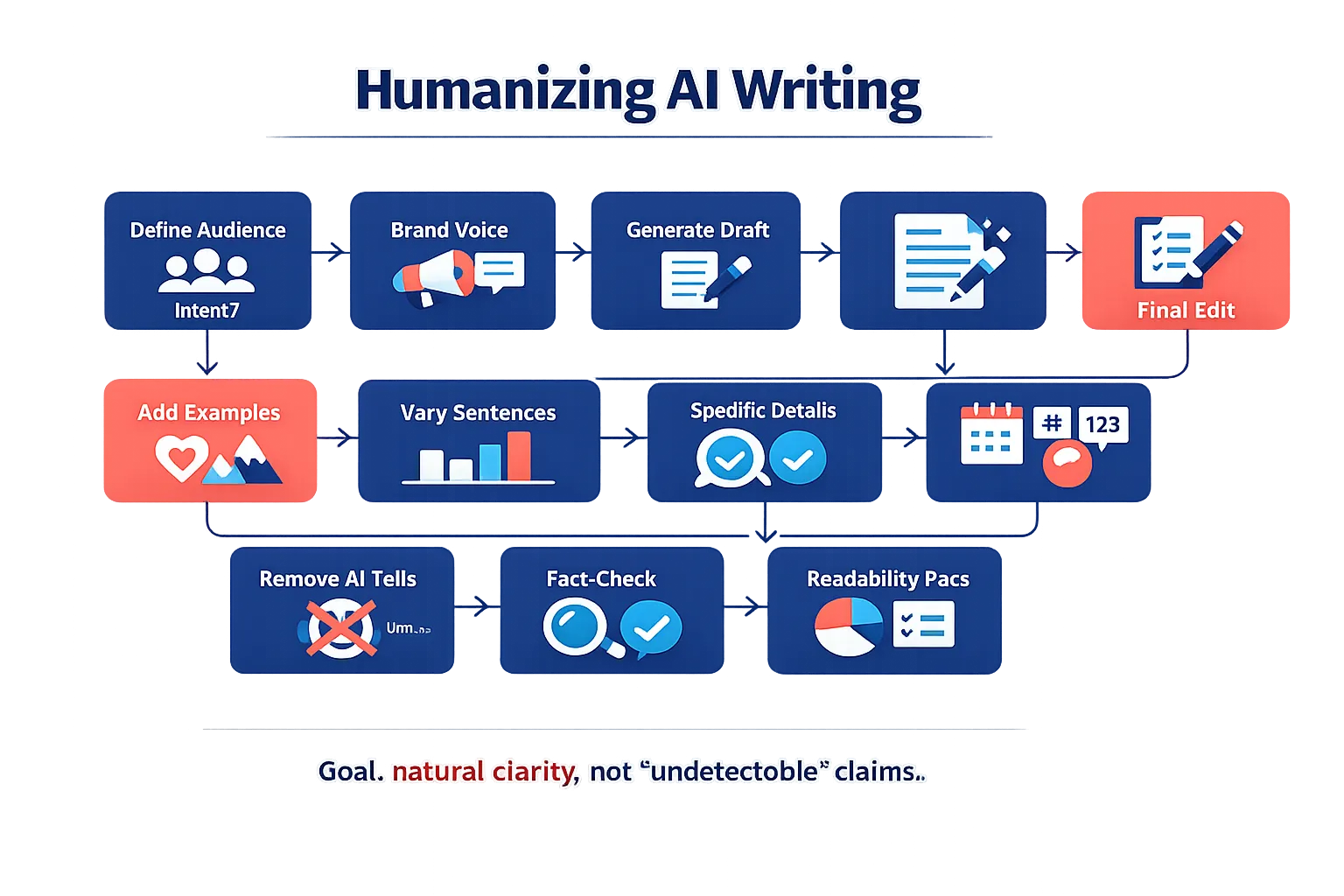
The best human-sounding output is usually created in two stages: (1) generate a structured draft with the right context, then (2) edit for specificity, voice, and verification.
Start with intent and a real POV
Before you generate text, lock these in:
- Audience: who is this for, specifically?
- Intent: are they comparing tools, learning, or buying?
- Point of view: what do you believe that competitors don't say clearly?
If you're producing SEO content, this is where Supawriter stands out: it's built to translate SERP intent into a complete article structure with keyword targeting and a consistent brand voice, so your draft starts closer to publishable.
Add specificity: numbers, names, constraints, and examples
Most AI-generated text sounds artificial because it's overly general. Improve it by adding:
- constraints: "for a Series A SaaS with a 2-person marketing team"
- numbers: timelines, budgets, step counts, benchmarks (only if true)
- examples: mini case snippets, before-and-after rewrites, realistic scenarios
- edge cases: when your recommendation doesn't apply
A simple rule: if a sentence could apply to any company, it probably doesn't sound human.
Do a human editor pass (style, structure, fact-checking)
Use a final pass that's less about paraphrasing and more about editorial judgment:
- Remove filler transitions ("Moreover," "In today's world," "It's important to note")
- Vary sentence length so the rhythm feels natural
- Replace generic claims with evidence or remove the claim
- Add 1 to 3 trustworthy citations for the most important facts
How to choose the most human AI writer for your use case
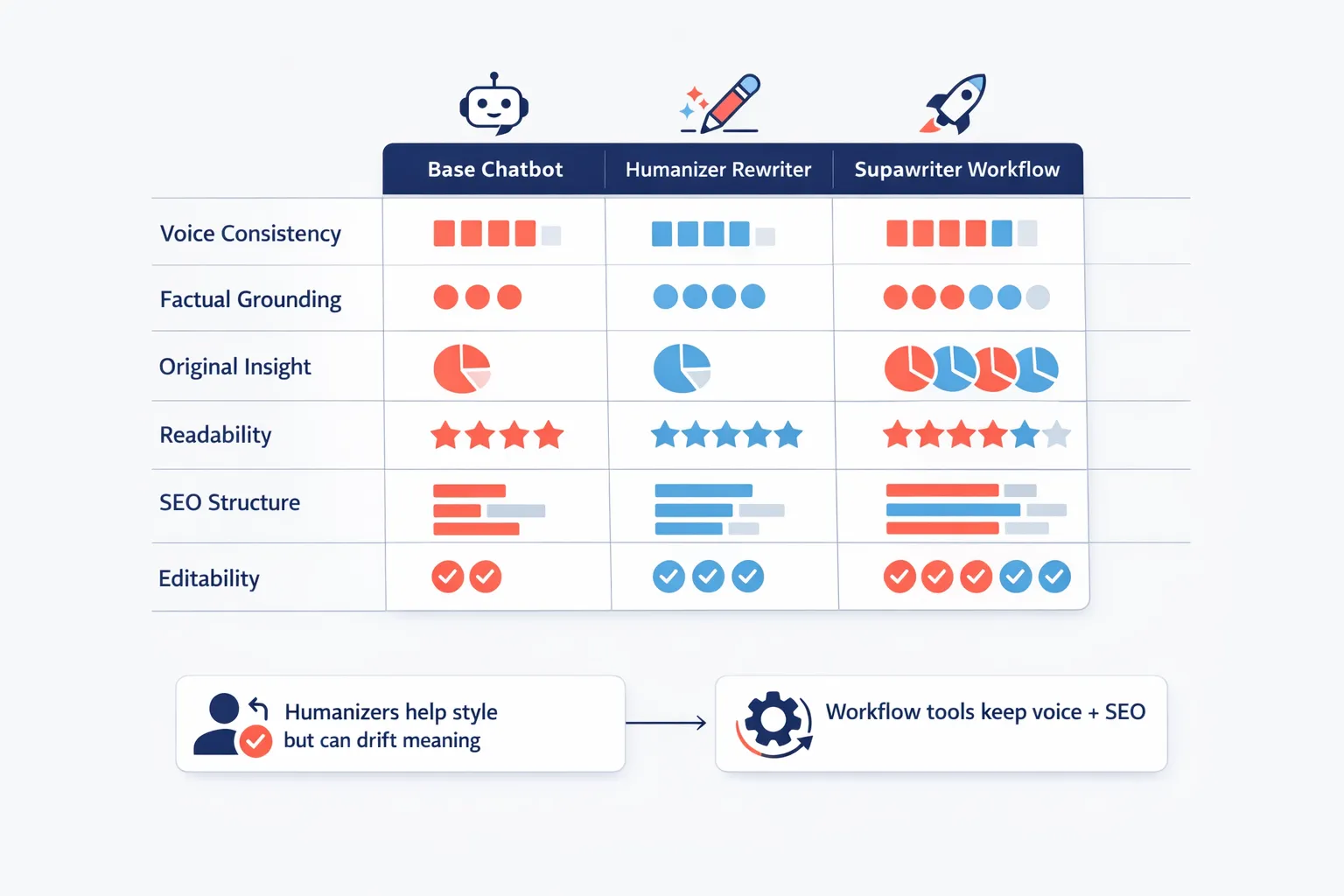
Different tools produce human-like results for different reasons. A chatbot may feel natural in conversation, while a humanizer can smooth awkward phrasing, and a content engine can keep your voice consistent across dozens of posts.
If you need marketing content that ranks
Pick a system that does more than rewrite. You'll want:
- consistent structure (H2s, H3s, scannability)
- keyword coverage without keyword stuffing
- internal linking and publishing workflow support
This is where Supawriter fits best, especially if you're building a repeatable engine for SEO content. Pair it with a solid strategy process like a step-by-step content strategy and you'll compound results faster than with one-off chatbot sessions.
If you need academic or compliance-sensitive writing
If stakes are high, prioritize:
- careful sourcing and citations
- conservative claims
- clarity about what's opinion vs fact
Also, avoid treating detector scores as proof. Vendors themselves acknowledge limitations and false positives, and policies vary by institution.
If you just want better chat and brainstorming
A chatbot is usually enough when:
- you're ideating angles
- you're outlining
- you're generating alternative phrasing
But once you move into publishable content, you'll still need the human editor pass and a consistent workflow.
FAQ: most human AI writer
What is the best free most human AI writer?
If you mean a free chatbot that can sound natural, a free tier of a mainstream chatbot can get you started, but the output won't automatically be "most human." The free approach that works best is: 1) generate a draft, 2) add specifics and examples, 3) edit for voice. If you're building a real publishing engine, consider a workflow tool rather than relying on free rewrites. You can also use this guide on what AI writing tools are in 2026 to map options by use case.
Can an AI humanizer keep the same meaning?
Sometimes, but not always. Humanizers can:
- unintentionally change technical meaning
- remove important qualifiers
- smooth writing so much it becomes less precise
If you use a humanizer, re-check any claims, steps, and numbers. For SEO pages, it's often safer to improve the draft at the source with clearer prompts and better structure than to repeatedly rewrite.
Will using an AI writer hurt SEO?
Using AI won't automatically hurt SEO. Thin, generic content can hurt SEO whether a human or AI wrote it. The goal is helpful content with strong structure, original insights, and accurate facts. A good process matters more than the label. If you're scaling content, you'll also benefit from a repeatable system like an on-page SEO checklist and an editorial workflow such as a content calendar.
If your real question behind "most human AI writer" is "what will I feel confident publishing," focus on tools that support voice, SEO structure, and governance. When it comes to producing human-sounding articles at scale without losing brand consistency, Supawriter gives you a strong foundation because it combines writing, optimization, research support, and publishing into one workflow.
Grow your traffic on autopilot now
Join thousands of users already using our platform.