How to Scale Content Production Without Sacrificing Quality
supawriter

If you want to scale content production, the goal is not to publish more for the sake of it. The goal is to build a system that helps your team produce more useful, search-ready, on-brand content without creating bottlenecks, missed deadlines, or a drop in quality. That is why effective content scaling starts with process, then tools, then volume.
For growing teams, this matters more than ever. According to B2B Content Marketing: 2025 Benchmarks & Trends, B2B marketers still depend heavily on content marketing, and the strongest teams put clear goals, documented strategy, and data-driven decision-making at the center of their programs. Separate analysis in 40+ B2B content marketing statistics you can't ignore in 2025 also points to strategy and workflow issues as common reasons teams underperform. When it comes to turning that strategy into consistent output, Supawriter gives teams a practical way to move from scattered drafting and manual publishing to a more scalable content operation.
What scaling content production actually means
Why more content is not the same as content scaling
A lot of teams confuse high volume with content scaling. They publish more blog posts, social assets, landing pages, or email campaigns, but the process behind the work stays messy. Writers still wait on briefs. Editors still rewrite first drafts from scratch. SEO checks still happen at the end. In that setup, production increases for a short time, then quality drops and the team burns out.
Real content scaling means your production system gets stronger as output grows. You are not asking people to do more. You are reducing friction so content can move faster through research, drafting, editing, optimization, publishing, and updating.
That usually means:
- clear content goals tied to marketing outcomes
- standardized briefs and templates
- defined handoffs between team members
- quality control at each stage
- smart use of AI and automation
- a CMS or workflow layer that keeps production organized
If your process only works when one editor keeps everything in their head, it is not scalable.
The main bottlenecks that stop teams from scaling
Most content teams hit the same problems when they try to increase production:
| Bottleneck | What it looks like | Result |
|---|---|---|
| Weak strategy | Too many topics, unclear priorities | Content output rises but traffic and leads do not |
| No standard briefs | Every writer starts from scratch | Slower production and inconsistent quality |
| Too many approvals | Content waits in review queues | Missed publishing targets |
| Poor brand guidance | Tone and messaging vary by writer | Brand inconsistency |
| Limited reuse | Teams create new assets every time | High cost per piece |
| Manual workflows | Publishing, linking, and optimization take too long | Team capacity stays low |
You can usually trace content production issues back to one of those six areas. That is good news because each one is fixable.
What success looks like for a scalable content program
A scalable program is easy to recognize. Your team can plan content weeks ahead, create briefs quickly, assign work clearly, and publish on a predictable cadence. Quality remains stable because writers know the expectations, editors have a repeatable review process, and SEO is built in from the start.
You should also see stronger performance over time. Instead of random bursts of content, you build topic coverage, internal links, and refresh cycles that compound. If you need a stronger strategic base for that, this guide to building a content strategy is a useful next step.
Build a content production system before you add volume
Start with strategy, goals, and content priorities
Before you scale anything, decide what kind of content deserves more investment. Not every content type should expand at the same speed. Some teams need more bottom-funnel pages. Others need a stronger blog program, help center, or thought leadership program.
Start with a few simple questions:
- Which topics map directly to pipeline, signups, or qualified traffic?
- Which formats perform best for your audience?
- Which channels can you realistically support each month?
- Where are your biggest content gaps compared with competitors?
This is where content scaling becomes a business decision, not just a production decision. Your team should know what to create, why it matters, and how success will be measured.
Google's guidance on scaled content matters here too. Search systems do not reward content simply because it was produced efficiently. The key is whether the content is helpful, original, and made for people first, not search manipulation, according to Google Search Central. So as you scale, keep usefulness and originality at the center of your process.
Standardize briefs, templates, and SOPs
Once priorities are clear, the fastest way to improve production is to standardize the work before writing begins.
A strong brief should include:
- target keyword and search intent
- audience and funnel stage
- angle or thesis
- required headings
- internal links to include
- sources or data points to reference
- CTA and conversion goal
- brand voice notes
Templates matter just as much. If every article, case study, or landing page starts with a blank page, your process stays slow. Templates reduce decision fatigue and make quality more consistent.
The same is true for SOPs. Document how content moves from idea to published asset. Include who owns each stage, how long each step should take, what review standards apply, and what happens if a draft misses the brief.
That sounds simple, but it is one of the biggest differences between teams that publish occasionally and teams that can scale content production month after month.
Create a workflow with clear roles and review stages
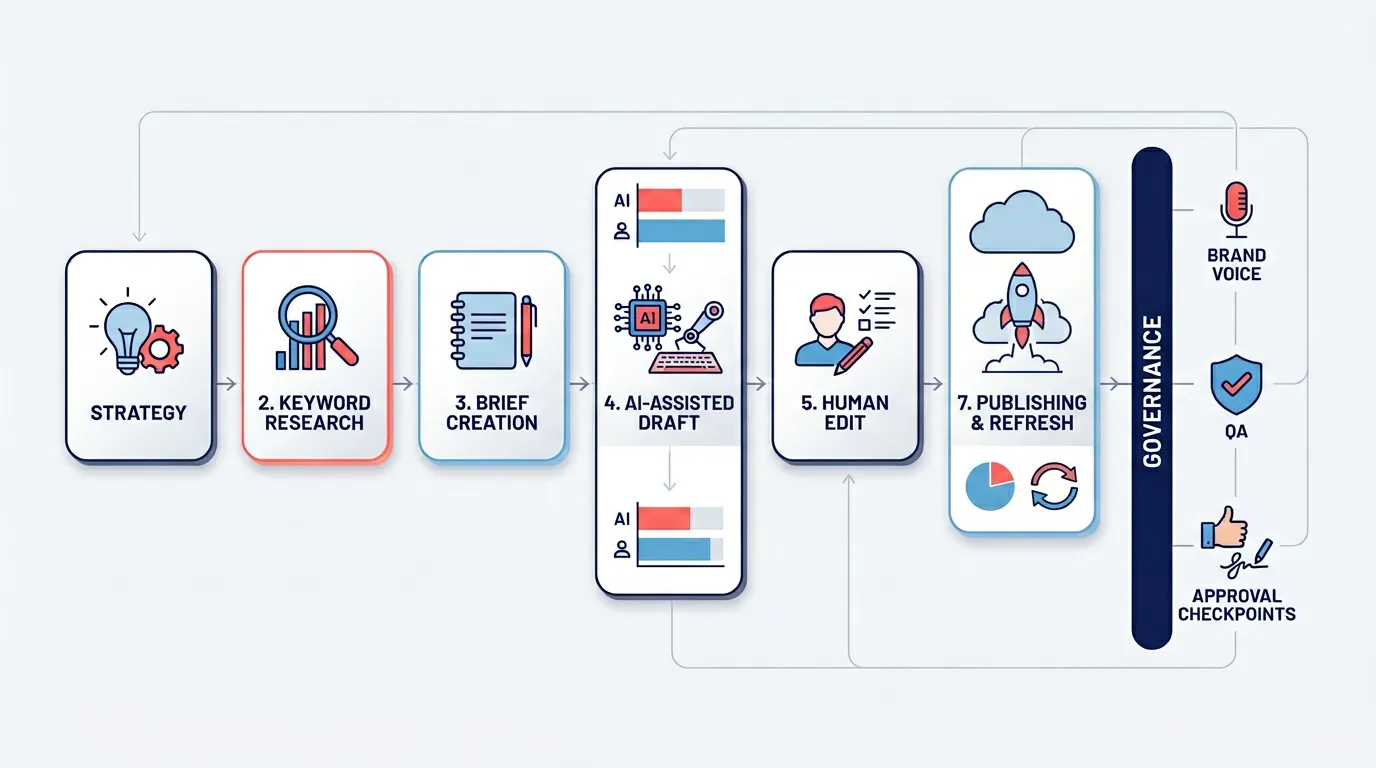
Next, turn your documentation into an actual workflow. At minimum, define these stages:
- planning
- research
- brief approval
- drafting
- editing
- SEO optimization
- publishing
- refresh and update
For each stage, assign an owner. This is where many teams get stuck. They know the steps, but ownership is vague. If nobody owns a step, it becomes a delay.
A simple structure might look like this:
| Stage | Primary owner | Main output |
|---|---|---|
| Topic planning | Content lead | Prioritized content calendar |
| Keyword research | SEO lead | Target keyword set and intent notes |
| Brief creation | Strategist or editor | Approved content brief |
| Drafting | Writer or AI-assisted writer | First draft |
| Editing | Editor | Revised, brand-safe draft |
| Optimization | SEO/editor | Metadata, internal links, on-page fixes |
| Publishing | Content ops | Live article in CMS |
| Refresh cycle | SEO/content lead | Updated and improved content |
If you need help structuring publishing around cadence, this article on how to build a content calendar fits naturally into the process.
Use AI to increase output without lowering quality
Where AI helps most in research, drafting, and optimization
AI can help you scale content creation, but only if you use it in the right parts of the workflow. The best use cases are usually the tasks that are repetitive, time-consuming, or highly structured.
For example, AI can help with:
- turning topic ideas into content briefs
- generating first-draft outlines
- expanding sections from approved notes
- rewriting for clarity and tone
- suggesting internal links
- creating metadata and social copy
- identifying content gaps and refresh opportunities
It can also speed up SEO operations. Teams that build automation into keyword clustering, drafting, and optimization often reduce production time significantly. If you are building that kind of system, our guide on automating SEO workflows can help connect the operational side with ranking goals.
What still needs human judgment and editing
Even strong AI tools should not replace editorial judgment. Human review is still essential for:
- brand positioning and messaging
- original insights and examples
- factual verification
- prioritizing what matters to the audience
- compliance or legal review
- final quality control
This balance matters because teams sometimes expect AI to solve a broken process. It will not. AI speeds up execution, but if strategy is weak or standards are unclear, it simply helps you produce weak content faster.
That is why your editorial layer has to stay intact. Writers, editors, SEO leads, and subject matter experts still shape quality. AI should remove friction, not remove accountability.
How Supawriter helps teams scale content production
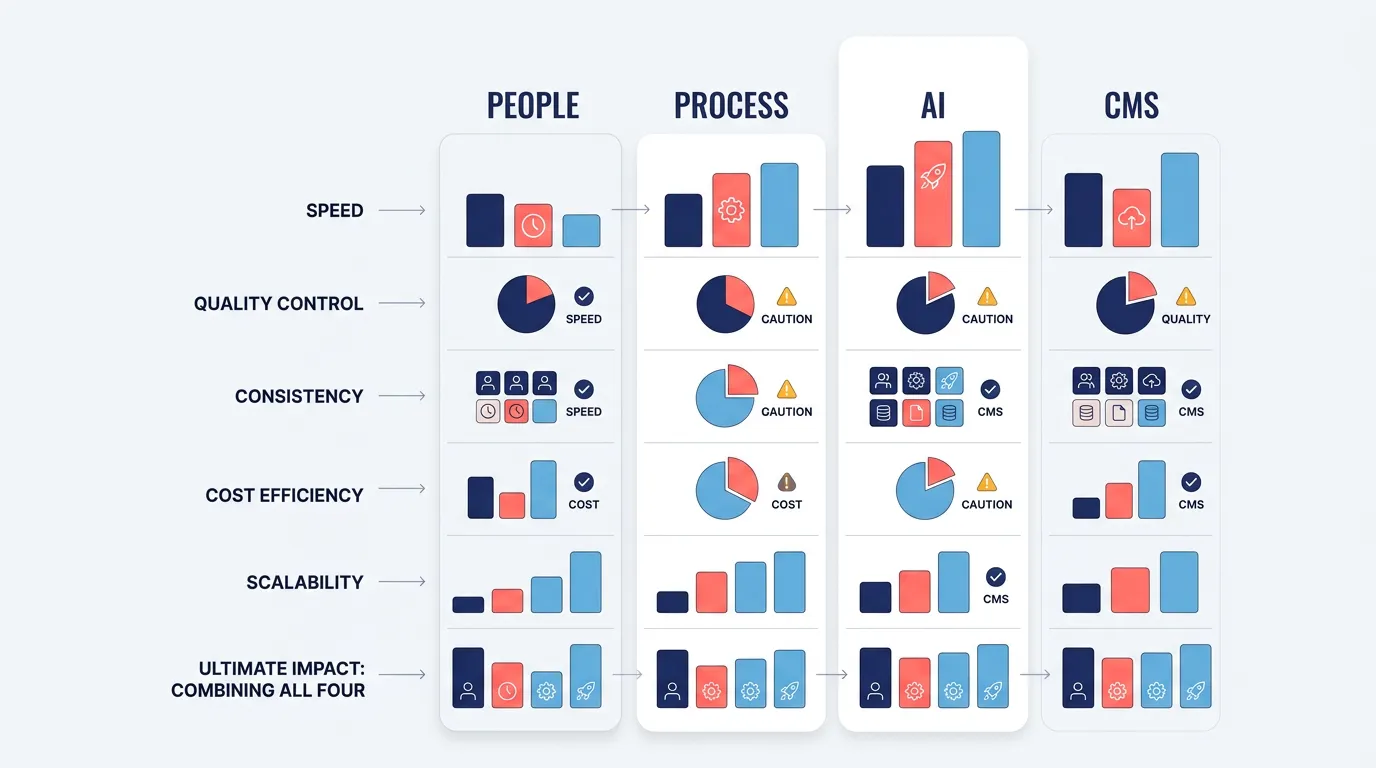
Achieving consistent content scaling is much easier with Supawriter because it combines several steps that are often spread across disconnected tools. Instead of juggling research docs, writing apps, SEO plugins, scheduling spreadsheets, and manual publishing, your team can manage more of the workflow in one place.
Supawriter helps teams produce long-form content aligned with brand voice, optimize posts around target keywords, generate internal linking suggestions, schedule publishing, and manage workflows through an integrated CMS. That is especially useful when your team wants more output but cannot afford more manual coordination.
In practice, that means you can move faster on high-priority topics while keeping editorial control. For teams evaluating their stack more broadly, this overview of AI writing tools can help frame what features matter most.
Improve throughput by repurposing and reusing content
Turn one core asset into multiple formats
One of the fastest ways to scale content production is to stop treating every asset as new work. A strong core piece can feed multiple channels and formats.
For example, one well-researched blog post can become:
- a newsletter section
- several social posts
- a short video script
- a sales enablement asset
- a webinar outline
- a checklist or downloadable lead magnet
This approach lowers production cost per idea and gives your marketing team more coverage without rebuilding everything from zero.
The key is to plan repurposing at the start, not as an afterthought. When you create a brief, note what derivative assets the piece should support. That keeps production connected across channels.
Build topic clusters instead of one-off posts
Repurposing helps with formats, but topic clusters help with search performance. Instead of publishing isolated articles, build content around related themes and intent stages.
For example, if your main cluster is content scaling, supporting articles might cover:
- content strategy
- editorial workflows
- AI writing tools
- on-page optimization
- content calendars
- internal linking
This makes production more efficient because research overlaps, briefs become easier to standardize, and internal linking grows naturally. It also improves SEO by helping search engines understand your topical depth.
If you want a practical foundation for that work, our guide to SEO content in 2026 is a strong companion piece.
Use your CMS and content library to reduce duplicate work
A lot of production waste happens because teams cannot find what they already have. They recreate examples, repeat research, or write overlapping articles because assets are scattered across folders and tools.
A stronger content library solves that. Store templates, approved messaging, visual assets, brand guidance, existing posts, and reusable research in a system your team can actually access.
This is where content operations and CMS choices matter. A good setup should make it easy to:
- find existing assets by topic or format
- see what has already been published
- identify refresh candidates
- manage approvals and scheduling
- maintain metadata and internal linking
When it comes to scaling output across a growing team, Supawriter helps here too. Its mix of writing, SEO optimization, workflow management, scheduling, visuals, and publishing support helps reduce the tool sprawl that often slows content production.
Measure scaling with quality, speed, and business impact
Track the right KPIs across production and SEO
If you only measure how many articles went live, you will get the wrong behavior. People will optimize for output, not results.
A better content scaling dashboard tracks three areas:
| Area | Metrics to track | Why it matters |
|---|---|---|
| Production speed | Time to brief, time to draft, time to publish, publishing cadence | Shows workflow efficiency |
| Quality | Edit rounds, factual errors, revision rate, brand compliance | Shows whether scaling is hurting standards |
| Business impact | Organic traffic, rankings, conversions, assisted pipeline | Shows whether content is creating value |
This balance is important because scaling should improve throughput and outcomes together. If output rises but rankings, conversions, or quality scores fall, the system needs work.
Fix issues with regular audits and refresh cycles
Scaling is not just about creating new content. It is also about maintaining what you already published. Older content can decay, become inaccurate, or lose rankings if it is not reviewed.
Build a refresh process into your production calendar. Review underperforming or aging content on a consistent basis, update examples, improve internal links, add missing sections, and align posts with current search intent.
This supports performance and keeps your library useful. It also aligns with Google's people-first guidance because you are improving content quality over time, not flooding your site with redundant pages, as explained by Google Search Central.
Scale gradually so your process stays stable
Finally, do not try to triple production overnight. The best teams scale in layers.
Start with one content type, one workflow, or one cluster. Fix bottlenecks. Document what works. Then expand.
A practical ramp might look like this:
| Phase | Focus | Goal |
|---|---|---|
| Phase 1 | Standardize briefs and templates | Reduce production variability |
| Phase 2 | Add AI to drafting and optimization | Increase speed |
| Phase 3 | Improve scheduling and CMS workflow | Increase publishing consistency |
| Phase 4 | Expand clusters and repurposing | Increase content coverage |
| Phase 5 | Add refresh cycles and audits | Protect long-term performance |
This slower approach usually scales faster in the real world because it protects quality and avoids rework.
If you are wondering how to scale content production, the short answer is this: build a repeatable system, use AI where it saves time, keep humans in charge of quality, and measure what actually matters. The teams that do this well do not just create more content. They build a better content engine.
If you want that engine to be easier to run, Supawriter is worth exploring. It helps content and SEO teams move from manual production to a more scalable workflow with writing, optimization, scheduling, visuals, and publishing working together instead of in separate tools.
Grow your traffic on autopilot now
Join thousands of users already using our platform.